VR-Together

VR-Together

VR-Together

A Horizon 2020 project developing photorealistic social VR for shared immersive experiences.

Project Info

Start date

October 2017

End date

December 2020

Funding

European Commission – Horizon 2020 (Grant Agreement No. 762111)

Website

CORDIS project page

Coordinator

Fundació i2CAT

Summary

VR-Together explores how photorealistic immersive content can enable compelling social virtual reality experiences. The project develops an end-to-end pipeline combining capture, encoding, network delivery and rendering technologies to bring remote participants together in shared virtual environments.

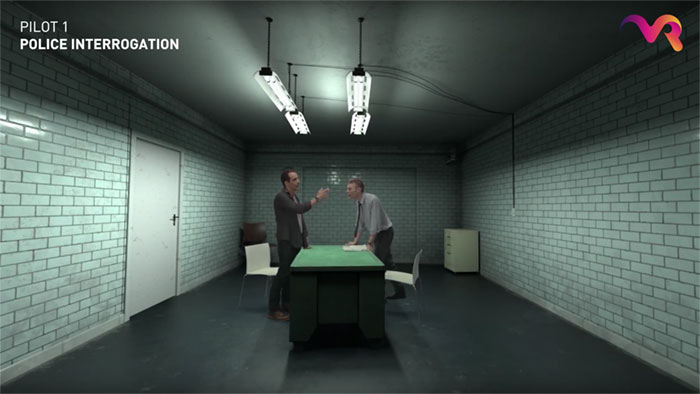
A key objective is to make high-quality social VR practical and scalable using a combination of advanced technologies and commercially available components. The platform supports both live and interactive immersive content and is evaluated through three pilot applications covering different production and usage scenarios.

The project also develops methods for evaluating social presence and user experience, together with quantitative benchmarks for assessing the performance of immersive media production and delivery pipelines.

Within VR-Together, Artanim contributed to content production for the three pilots, combining VR with offline and real-time motion capture. Artanim also developed tools for immersive media production and participated in the evaluation of the resulting social VR experiences.

Partners

Fundació i2CAT (Spain)

Netherlands Organisation for Applied Scientific Research – TNO (The Netherlands)

Centrum Wiskunde & Informatica – CWI (The Netherlands)

Centre for Research and Technology Hellas – CERTH (Greece)

Viaccess-Orca (France)

Entropy Studio (Spain)

Motion Spell (France)

Artanim (Switzerland)

Related Publications

Galvan Debarba H, Montagud M, Chagué S, Lajara J, Lacosta I, Fernandez Langa S, Charbonnier C. Content Format and Quality of Experience in Virtual Reality, Multimed Tools Appl, 83:46481–46506, 2024.
PDF · DOI

Galvan Debarba H, Chagué S, Charbonnier C. On the Plausibility of Virtual Body Animation Features in Virtual Reality, IEEE Trans Vis Comput Graph, 28(4):1880–1893, 2022.
PDF · DOI

Revilla A, Zamarvide S, Lacosta I, Perez F, Lajara J, Kevelham B, Juillard V, Rochat B, Drocco M, Devaud N, Barbeau O, Charbonnier C, de Lange P, Li J, Mei Y, Lawicka K, Jansen J, Reimat N, Subramanyam S, Cesar P. A Collaborative VR Murder Mystery using Photorealistic User Representations, Proc. IEEE Conf. on Virtual Reality and 3D User Interfaces (VRW 2021), IEEE, pp. 766, March, 2021.
PDF · DOI

Chatzitofis A, Saroglou L, Boutis P, Drakoulis P, Zioulis N, Subramanyam S, Kevelham B, Charbonnier C, Cesar P, Zarpalas D, Kollias S, Daras P. HUMAN4D: A Human-Centric Multimodal Dataset for Motions & Immersive Media, IEEE Access, 8:176241–176262, 2020.
PDF · DOI

De Simone F, Li J, Galvan Debarba H, El Ali A, Gunkel S, Cesar P. Watching videos together in social Virtual Reality: an experimental study on user’s QoE, Proc. 2019 IEEE Virtual Reality, IEEE, 890–891, March, 2019.
PDF · DOI
3D Proto

3D Proto

3D Proto

A virtual prototyping project improving sportswear fit through 3D simulation and body motion.

Project Info

Start date

November 2015

End date

December 2016

Funding

Commission for Technology and Innovation (CTI) – Project No. 18124.1 PFES-ES

Coordinator

Geneva University of Art and Design (HEAD)

Summary

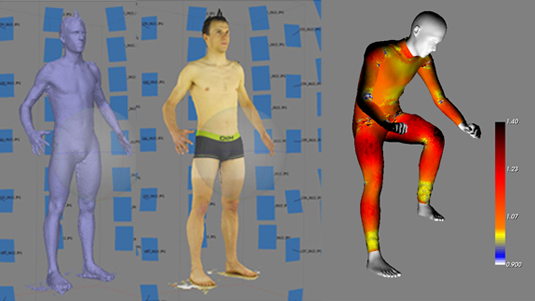
3D Proto investigates how virtual 3D prototyping can improve the design, fit and performance of technical sportswear. Detailed simulations provide quantitative information on how garments interact with the body, including areas of compression and deformation that are difficult to assess using conventional static prototypes.

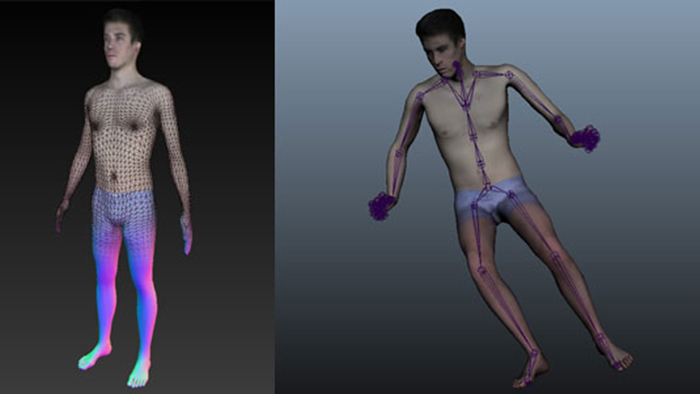
The project focuses on improving garment prototyping workflows for the active sportswear sector by characterizing the physical and mechanical properties of technical fabrics and combining them with animated 3D body models. This allows sports garments to be simulated and evaluated under realistic movement conditions.

Within 3D Proto, Artanim provided realistic body animations for alpine skiing, Nordic skiing, running and hiking. Artanim also developed software tools to support fabric measurement protocols through the analysis of body motion and deformation.

Partners

Christiane Luible – Geneva University of Art and Design (HEAD)
Fabric characterization and 3D garment simulation.

Caecilia Charbonnier – Artanim
Motion capture, body modeling and animation, and development of software for body motion and garment deformation analysis.

Ulrike Froitzheim – Odlo International SA
3D garment design and industrial supervision.

Fashioning Movement

Fashioning Movement

Fashioning Movement

A research project exploring garment comfort and fit through animated 3D body simulation.

Project Info

Start date

November 2013

End date

October 2015

Funding

HES-SO

Coordinator

Geneva University of Art and Design (HEAD)

Summary

Fashioning Movement investigated how body movement affects garment comfort and fit. While conventional garment evaluation is largely based on static postures and subjective assessment, the project explored how animated 3D body models and garment simulation could provide objective, quantitative information on the interaction between the body, fabric and clothing during movement.

The research combined body motion with 3D garment simulation to analyze garment deformation and fit under dynamic conditions. The resulting numerical data provided new ways to evaluate comfort and supported the exploration of garment design and pattern-making methods that take movement into account from the early stages of development.

A pilot project was developed within this research to demonstrate the approach in practice. View the pilot project.

Partners

Geneva University of Art and Design (HEAD)
3D garment design and simulation.

Artanim
Motion capture, body modeling and animation, and development of software for garment deformation analysis.

Collaborators
Odlo International, Salomon and Empa – Swiss Federal Laboratories for Materials Science and Technology.

Related Publications

Mert E, Psikuta A, Joshi A, Arevalo M, Charbonnier C, Luible-Bär C, Annaheim S, Rossi R. The distribution of air gap thickness and the contact area during Alpine skiing, Proc. of 9th Int. Conf. on 3D Body Scanning Technologies, Lugano, Switzerland, October, 2018.
PDF · DOI

Mert E, Psikuta A, Arevalo M, Charbonnier C, Luible-Bär C, Bueno MA, Rossi R. A validation methodology and application of 3D garment simulation software to determine the distribution of air layers in garments during walking, Measurement, 117:153-164, 2018.
PDF · DOI

Luible C, Charbonnier C. Fashioning Movement: a new approach to Fashion Design, In Unfrozen – Design Research Today, Edited by Swiss Design Network, Triest Verlag, 2017.
PDF

Mert E, Psikuta A, Arevalo M, Charbonnier C, Luible C, Bueno MA, Rossi RM. Quantitative validation of 3D garment simulation software for determination of air gap thickness in lower body garments, IOP Conf. Series: Materials Science and Engineering, 254(16):162007, 2017.
PDF · DOI

Mert E, Psikuta A, Arevalo M, Charbonnier C, Luible C, Bueno MA, Rossi RM. Quantitative validation of 3D garment simulation software for determination of air gap thickness in lower body garments, AUTEX World Textile Conference, Corfu, Greece, May, 2017.

Luible C, Charbonnier C. Fashioning Movement: a new approach to Fashion Design, Unfrozen Symposium, 1st SDN Design Research Winter Summit, Giessbach, Switzerland, January, 2016.
PDF

To Fit

To Fit

To Fit

A 3D body digitization project combining head and body scans into a complete animatable avatar.

Project Info

Start date

June 2014

End date

April 2015

Funding

ToFit Sàrl

Coordinator

Artanim

Summary

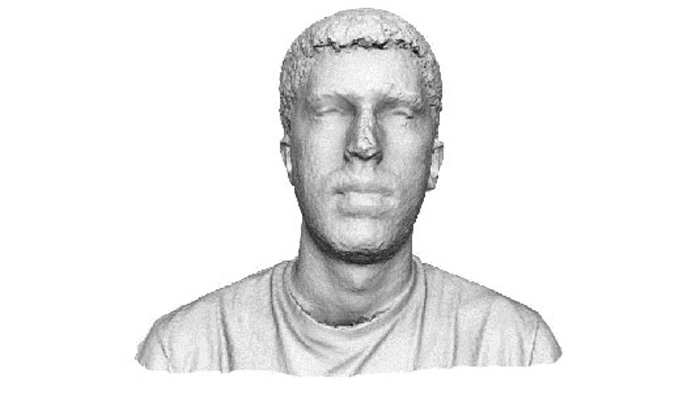
ToFit aimed to create a complete 3D avatar of a user by combining head and body scans acquired with different scanning technologies. A first part of the project focused on developing an affordable multi-camera system capable of producing high-quality textured head scans, with sufficient visual fidelity to achieve a convincing representation of the user.

The second part focused on merging the head scan with full-body scan data using template fitting. This process enabled the generation of a unified 3D body model, the extraction of body measurements and the automatic creation of an internal skeleton for animation.

Taylormatic

Taylormatic

Taylormatic

A multi-platform retail solution combining 3D product customization, body scanning and virtual try-on.

Project Info

Start date

December 2012

End date

October 2014

Funding

NoBrandSolution Sàrl

Coordinator

Artanim

Summary

Taylormatic was developed as a multi-platform product presentation and customization solution for retail. The platform allowed designers and manufacturers to present configurable products as realistic interactive 3D models, while enabling customers to personalize products and visualize the result before production.

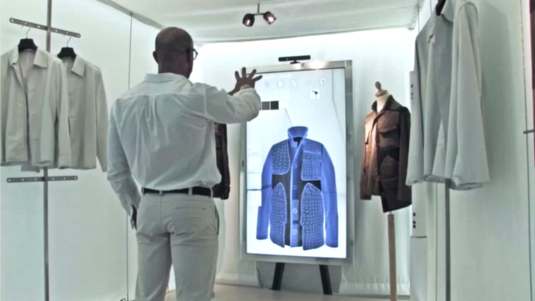
As part of the project, Artanim developed a Kinect-based gesture recognition system and a multi-Kinect body scanning solution. The scanner was designed to estimate the body dimensions of fully dressed customers and support automatic size recommendations for compatible products.

The project also addressed the complete 3D asset production pipeline, from initial design to deployment in interactive applications. Artanim developed Unity asset-management tools for organizing, exporting and associating metadata with 3D content.

Using this pipeline, several applications were developed, ranging from an in-store virtual mirror to optimized iOS and Android experiences. The system was designed to support different product categories, customization options and brand identities within a shared technical framework.

Partners

NoBrandSolution Sàrl
Concept development, commercialization, and 3D asset design and production.

Artanim
Body scanning, gesture recognition, application development, and 3D asset management tools.