HoloMed

HoloMed

HoloMed

AR tools for medicine

Project Info

Start date:
September 2016

End date:
February 2018

Funding:
La Tour Hospital / Hirslanden Clinique La Colline

Coordinator:
Artanim

Summary

In medicine, augmented reality (AR) technology can offer added value over traditional education, assessment and interventional approaches. By combining our expertise in motion capture, 3D anatomical modelling and AR technology, new solutions can be proposed to improve medical treatment.

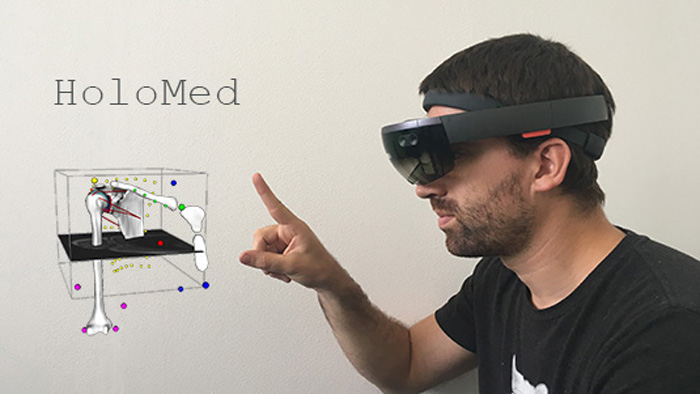
In this project, we developed an anatomical see-through tool to visualize and analyze patient’s anatomy in real time and in motion for applications in sports medicine and rehabilitation. This tool allows healthcare professionals to visualize joint kinematics, where the bones are accurately rendered as a holographic overlay on the subject (like an X-ray vision) and in real-time as the subject performs the movement.

Partners

Artanim
Development of AR solutions

La Tour Hospital – Division of Orthopedic and Trauma Surgery
Clinical tests

Hirslanden Clinique La Colline – Division of Orthopedic and Trauma Surgery
Clinical tests

Related Publications

Elias de Oliveira M, Galvan Debarba H, Lädermann A, Chagué S, Charbonnier C. A Hand-Eye Calibration Method for Augmented Reality Applied to Computer-Assisted Orthopedic Surgery, Int J Med Robot Comput Assist Surg, 15(2):e1969, 2019.
PDF

Elias de Oliveira M, Galvan Debarba H, Lädermann A, Chagué S, Charbonnier C. Réalité augmentée en chirurgie orthopédique. Mythe ou réalité ?, Congrès de la Société Francophone d’Arthroscopie 2018, Paris, France, Revue de chirurgie orthopédique et traumatologique, 104(8):S110, November 2018.
PDF

Galvan Debarba H, Elias de Oliveira M, Lädermann A, Chagué S, Charbonnier C. Augmented Reality Visualization of Joint Movements for Rehabilitation and Sports Medicine, 20th Symposium on Virtual and Augmented Reality (SVR), Foz Do Iguaçu, Brazil, October 2018.
PDF

Galvan Debarba H, Elias de Oliveira M, Lädermann A, Chagué S, Charbonnier C. Augmented Reality Visualization of Joint Movements for Physical Examination and Rehabilitation, Proc. 2018 IEEE Virtual Reality, IEEE Comput. Soc, March 2018.
PDF

Galvan Debarba H, Elias de Oliveira M, Lädermann A, Chagué S, Charbonnier C. Tracking a Consumer HMD with a Third Party Motion Capture System, Proc. 2018 IEEE Virtual Reality, IEEE Comput. Soc, March 2018.
PDF

Elias de Oliveira M, Galvan Debarba H, Lädermann A, Chagué S, Charbonnier C. Development of a Hand-Eye Calibration Method for Augmented Reality Applied to Computer-Assisted Orthopedic Surgery, 32nd International Congress of Computer Assisted Radiology and Surgery, Heidelberg, Germany, Int J CARS, June 2018.
PDF
Reverse Shoulder Arthroplasty

Reverse Shoulder Arthroplasty

Reverse Shoulder Arthroplasty

Dynamic simulation of RSA

Project Info

Start date:
January 2017

End date:
December 2017

Funding:
Hirslanden Clinique La Colline

Coordinator:
Artanim

Summary

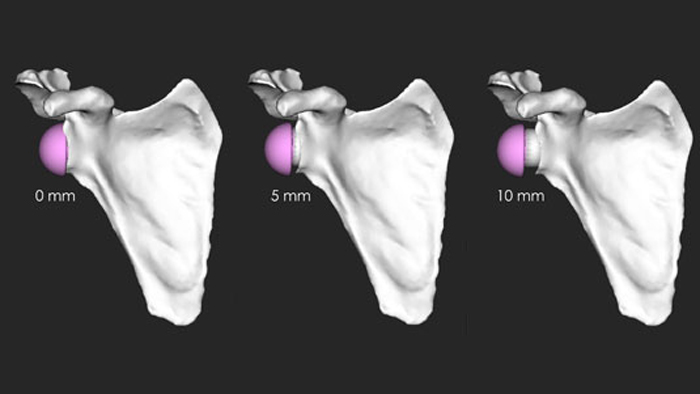
The goal of this project was to simulate reverse shoulder prostheses (RSA) to evaluate the variability of several biomechanical factors and the impact on the range of motion. In particular, we were interested in evaluating the effect of glenoid lateralization, humeral inclination and critical shoulder angle (CSA). These computer-assisted simulations provided operating parameters which aimed to minimize the onset of articular conflicts and luxations.

In this project, Artanim was responsible for dynamically simulating reverse shoulder prostheses from kinematic data.

Partners

Artanim
Simulation of reverse shoulder prostheses

Hirslanden Clinique La Colline – Division of Orthopedic and Trauma Surgery
Clinical tests

Related Publications

A. Läderman, E. Tay, P. Collin, S. Piotton, J.C.H. Chiu, A. Michelet, C. Charbonnier. Effect of critical shoulder angle, glenoid lateralization and humeral inclination on range of motion in reverse shoulder arthroplasty, Bone Joint Res, 8:378-386, 2019.
PDF

C. Charbonnier, E. Tay, P. Collin, S. Piotton, J.C.H. Chiu, A. Michelet, A. Läderman. Effect of critical shoulder angle, glenoid lateralization and humeral inclination on ROM in reverse shoulder arthroplasty, Swiss Med Wkly, 149(Suppl. 236):2S, 2019.
PDF


VR_I

VR_I

VR_I

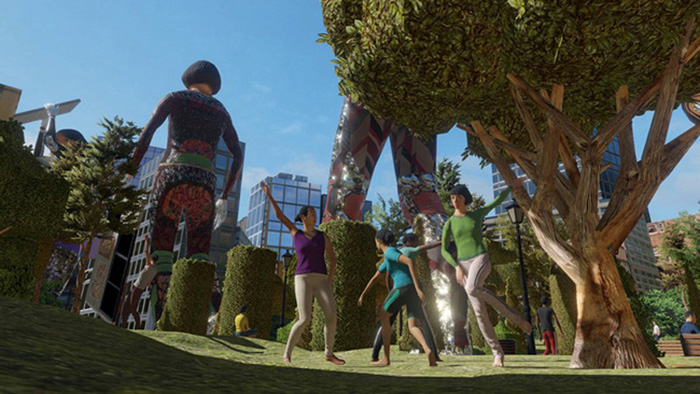
Dance piece in immersive VR

Project Info

Producer:
Cie Gilles Jobin

Year:
2017

Summary

Blending art with technology, Gilles Jobin in collaboration with Artanim developed VR_I, a work in which the creator questions our perception of reality and enters new unexplored and unchartered territories for contemporary dance. Thanks to the virtual reality (VR) technology developed by Artanim, VR_I viewers equipped with VR headsets and backpack computers move freely in a total virtual space.

Five viewers at a time may explore this world, moving in turn in an endless desert, an urban landscape or inside a loft at the top of a mountain. Participants each embody an avatar that faithfully replicates their movements, enhancing the feeling of immersion in the virtual world while also enabling them to see their peers. During the experience, participants can thus interact physically and even communicate with the others. Five virtual dancers then come to blur their perception, multiplying, growing to the point of becoming giants or becoming tiny. With these effects of scale, Gilles Jobin addresses the concept of spatiality in a truly original way.

VR_I was selected at the 2018 Sundance Film Festival and received, among others, the Grand Prix Innovation and the Audience Award for best performance at the 49th edition of the Festival du nouveau cinéma de Montréal. VR_I was on tour around the globe from 2017-2020.

More information on the VR technology here.

Credits

A project by Cie Gilles Jobin and Artanim

Production
Cie Gilles Jobin

Choreography
Gilles Jobin

3D scans and motion capture
Artanim

VR platform and immersive technology
Artanim

Awards and Recognitions

Wind Clothing

Wind Clothing

Wind Clothing

3D scanning

Project Info

Client:
Fédération Française de Ski (FFS)

Year:
2017

Summary

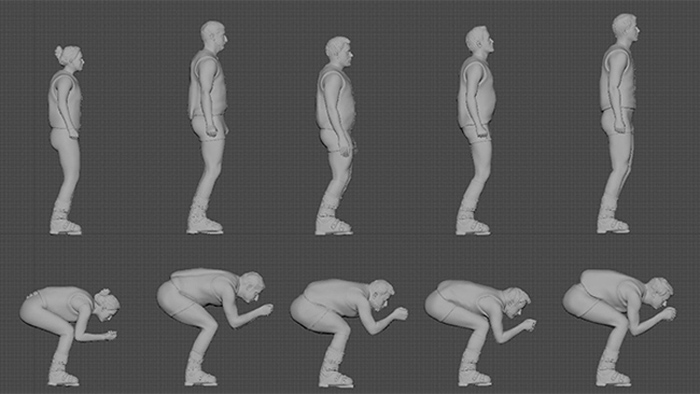
We collaborated with the French Ski Federation (FFS) to make 3D scans of their best ski cross athletes. From the 3D bodies, garments were made to measure to maximize the aerodynamics of athletes at downhill. Technical clothing that earned them precious hundredths at the Olympics in PyeongChang 2018.

3D Proto

3D Proto

3D Proto

Sportswear garment prototyping

Project Info

Start date:
December 2015

End date:
December 2016

Funding:
Commission for Technology and Innovation (CTI)

Coordinator:
Geneva University of Art and Design (HEAD)

Summary

A sample model on a higher technological level, such as a precise virtual 3D prototype, contains innovative numerical fitting information (e.g., data about the areas of compression of a garment) that could improve the design and quality of the final sports garment and better satisfy the customer.

The aim of this research project was thus to reform existing garment prototyping processes for the active sportswear sector. The main focus was on the definition of accurate physical and mechanical high-tech sports fabric properties and on the use of virtual sports body animations to perform accurate simulation of sports garments.

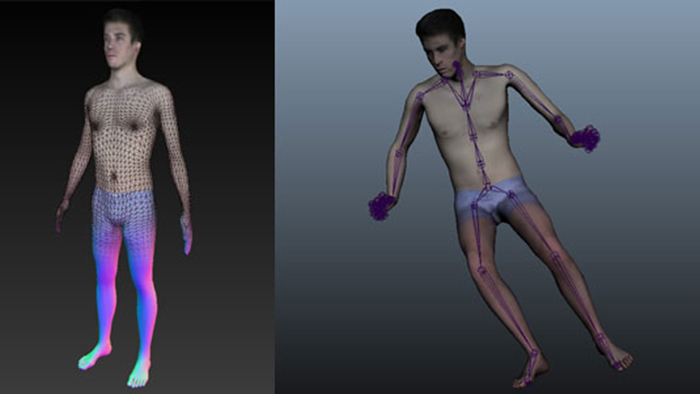
In this project, Artanim was in charge of providing realistic body animations of different sports (alpine skiing, Nordic skiing, running and hiking). Moreover, Artanim worked on the development of software tools to improve the fabric measurements protocol by analyzing body motion and deformation.

Partners

Geneva University of Art and Design (HEAD)
Fabric measurements and garments 3D simulation

Artanim
Motion capture, body modeling and animation, development of body motion and garment deformation analysis software

Odlo International SA
Garments 3D design and industrial supervision