
Reverse Shoulder Prosthesis Simulation
A biomechanical simulation study evaluating implant configuration and shoulder range of motion.Project Info
Start date
January 2017
End date
December 2017
Funding
Hirslanden Clinique La Colline
Coordinator
Artanim
Summary
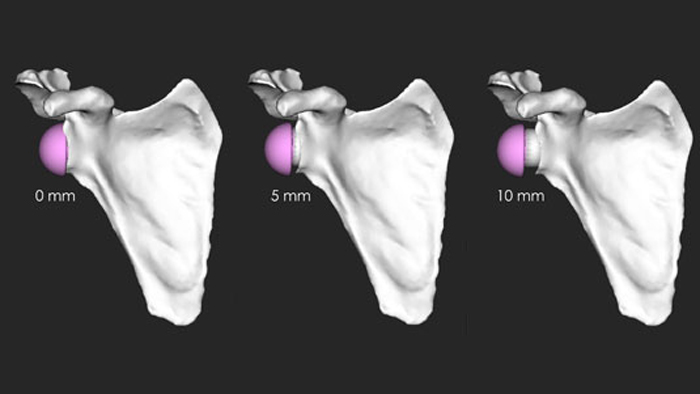
Reverse Shoulder Prosthesis Simulation investigates how different implant and anatomical parameters affect shoulder range of motion after reverse shoulder arthroplasty (RSA).
The study focuses in particular on glenoid lateralization, humeral inclination and critical shoulder angle (CSA), using computer-assisted simulations to evaluate their influence on joint mechanics and the risk of impingement or instability.
The objective is to identify surgical parameters that can help optimize implant configuration and reduce the risk of articular conflict and dislocation.
Within the project, Artanim was responsible for the dynamic simulation of reverse shoulder prostheses using kinematic data.
Partners
Artanim
Simulation of reverse shoulder prostheses.
Hirslanden Clinique La Colline – Center for Orthopaedic Surgery and Musculoskeletal Traumatology
Clinical testing and medical supervision.
Related Publications
Lädermann A, Tay E, Collin P, Piotton S, Chiu JCH, Michelet A, Charbonnier C. Effect of critical shoulder angle, glenoid lateralization and humeral inclination on range of motion in reverse shoulder arthroplasty, JSES Open Access, 3:240, 2019.
PDF · DOI
Lädermann A, Tay E, Collin P, Piotton S, Chiu JCH, Michelet A, Charbonnier C. Effect of critical shoulder angle, glenoid lateralization and humeral inclination on range of movement in reverse shoulder arthroplasty, Bone Joint Res, 8:378–386, 2019.
PDF · DOI
Charbonnier C, Tay E, Collin P, Piotton S, Chiu JCH, Michelet A, Lädermann A. Effect of critical shoulder angle, glenoid lateralization and humeral inclination on ROM in reverse shoulder arthroplasty, Swiss Med Wkly, 149(Suppl. 236):2S, 2019.
PDF