MRgHIFU Ablation of Liver Tumors

MRgHIFU Ablation of Liver Tumors

MRgHIFU Ablation of Liver Tumors

Minimally invasive intervention

Project Info

Start date:
July 2019

End date:
June 2023

Funding:
Swiss National Science Foundation (SNSF)

Coordinator:
HUG – Division of Radiology

Summary

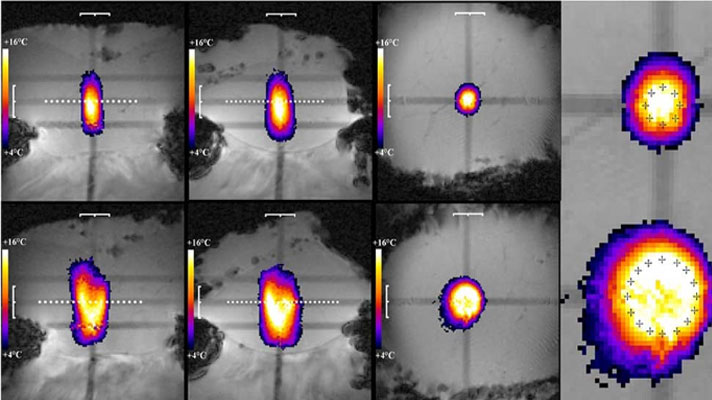
High intensity focused ultrasound (HIFU) is a precise method to thermally ablate deep-seated tumors in a non-invasive manner. A prerequisite for a safe and effective application of HIFU is image guidance, to plan and control the ablation process. The most suitable imaging modality is MRI, with its high soft tissue contrast and its ability to monitor tissue temperature changes (MR-guided HIFU, MRgHIFU). The therapy of abdominal organs, such as the liver, still poses several problems due to a moving target location caused by breathing, motion related MR-thermometry artefacts and near-field obstacles, i.e. thoracic cage or bowel.

The goal of this project is to treat unresectable liver malignancies with MRgHIFU, using fast volumetric ablation. Enlarged acoustic window and enhanced focusing number of the HIFU applicator, rapid automatic control of volumetric sonication, as well as self-scanning of the lesion by exploiting the respiratory motion are envisaged in this research.

In this project, Artanim was in charge of the segmentation of target region (tumor) and organs at risk, as well as the computation of the optimal transducer positioning of the robotic assistance system taking into account the segmented structures and the coverage target area.

Partners

University Hospitals of Geneva – Division of Radiology
Imaging, data analysis, transducer development, clinical tests and project coordination

Artanim
Segmentation of target region and organs at risk, transducer positioning

University Hospitals of Geneva – Division of Oncology
Clinical tests

Related Publications

M’Rad Y, Charbonnier C, Elias de Oliveira M, Guillemin PC, Crowe LA, Kössler T, Poletti P-A, Boudabbous S, Ricoeur A, Salomir R, Lorton O. Computer-Aided Intra-Operatory Positioning of an MRgHIFU Applicator dedicated to Abdominal Thermal Therapy using Particle Swarm Optimization, IEEE Open J Eng Med Biol, IEEE, 2644-1276:1-11, 2024.
PDF

Lorton O, Guillemin PC, M’Rad Y, Peloso A, Boudabbous S, Charbonnier C, Holman R, Crowe LA, Gui L, Poletti P-A, Ricoeur A, Terraz S, Salomir R. A Novel Concept of a Phased-Array HIFU Transducer Optimized for MR-Guided Hepatic Ablation: Embodiment and First In-Vivo Studies, Front Oncol, 30(12):899440, 2022.
PDF
 

Aboard the Mayflower

Aboard the Mayflower

Aboard the Mayflower

A VR experience

Project Info

Client:
International Museum of the Reformation

Year:
2020

Summary

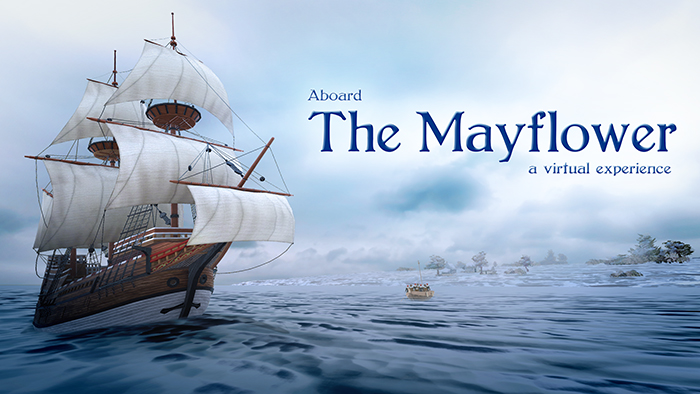
In November 1620, the passengers and crew of the Mayflower reached the coast of Massachusetts and established a colony there. Among them were Puritan Reformers who crossed the ocean to found a community in accordance with their aspirations. This episode is considered in the USA as a founding moment of the country.

This VR installation immerses users into the life of these pioneers just before they decide to land. Using a very light set-up, based on Oculus Quest, you begin your journey by discovering details of the Reformation Wall of Geneva before being transported inside the Mayflower in 1620 to witness the discussions between the pilgrims. Finally, you discover the bay of Cape Cod from the upper deck of the boat in the cold winter.

The exhibition was open from October 28th, 2020 until August 31st, 2021 at MIR – International Museum of the Reformation.

Credits

Original idea and scientific committee

MIR – Gabriel de Montmollin, Hanna Woodhead

Production, direction, screenplay, 3D content creation, gameplay, photogrammetry and motion capture
Artanim

Actors
Vincent Coppey, José Lillo, Edmond Vuilloux

Sound design
ActMedia – Felicien Fleury, Alain Renaud

Voice over
Sabina Foeth

Dubbing
Tony Clark, Jonathan Cotton, Jan Peter Richter, William Sage, James Smillie, Thomas Stecher

Superimposed Realities

Superimposed Realities

Superimposed Realities

A cycle of immersive experiences to showcase the Nyon amphitheater

Project Info

Client:
TypicalOffice

Year:
2020

Summary

Built at the beginning of the 2nd century AD. and discovered in 1996 during earthworks, the amphitheater of Nyon is the sixth amphitheater unearthed in Switzerland and one of the most remarkable for its size and good conservation.
 
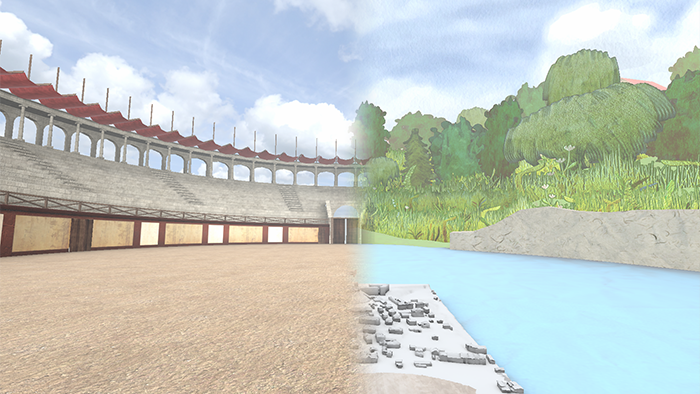
To enhance this archaeological site, a scenography designed specifically inside the arena allows visitors to wander freely on the site and discover there, in the form of three unique VR experiences, several temporal and spatial realities of the place.
 
About the three VR experiences:
Noviodunum | Historical experience
Based on the historical reconstruction carried out by Archeodunum and the Roman Museum of Nyon, this first experience offers visitors the opportunity to enter the amphitheater of Nyon in its Roman era.
 
Julius II Project | Architectural experience
In 2002, an international architectural competition was launched to convert the site of the amphitheater into an archaeological visitation site open to the public. This experience allows you to discover the winning project designed by the architect Bernard Pahud.
 
Rêverie | Artistic experience
Like the imaginary world of a child, participants are immersed in a fictional colorful illustration, where flora and fauna have reclaimed the remains of the amphitheater and the space occupied until today by humans.
 
The exhibition was open on October 3rd and 4th 2020 inside the Roman Amphitheater, Nyon.

Credits

Original idea
TypicalOffice
Yony Santos
Damien Greder

Production, direction, 3D content creation and gameplay
Artanim

Project leaders
Fondation pour le développement du Musée romain – Daniel Rosselat
Service de la culture de la ville de Nyon – Monique Dubey, Veronica Tracchia
Fabienne Freymond

Consultants
Musée romain de Nyon – Veronique Rey-Vodoz, Izmini Farassopoulos
Bernard Pahud architecte
Archeodunum – opérateurs en archéologie préventive, Pierre Hauser

VR+4CAD

VR+4CAD

VR+4CAD

Closing the VR-loop around the human in CAD

Project Info

Start date:
June 2020

End date:
November 2021

Funding:
Innosuisse

Coordinator:
Artanim

Website:
https://vrplus4cad.artanim.ch/

Summary

VR+4CAD aims to tackle issues limiting the use of VR in manufacture and design as highlighted by the industries: the lack of full circle interoperability between VR and CAD, the friction experienced when entering a VR world and the limited feedback provided about the experience for future analysis.

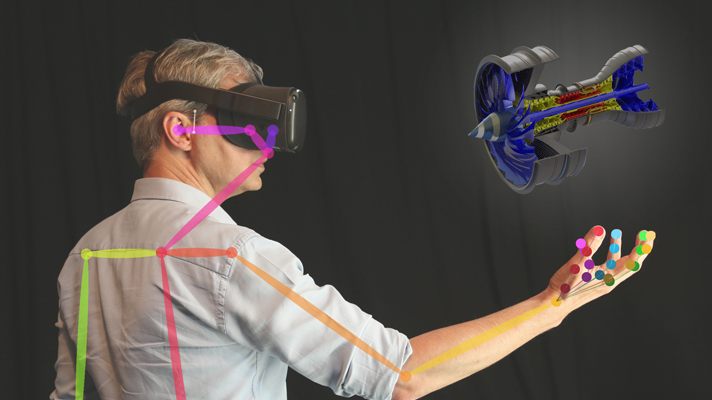
In this project, we target CAD-authored design to be automatically converted and adapted for (virtual) human interaction within a virtual environment. Interaction is made more immediate by means of an experimental, markerless motion capture system that relieves the user from wearing specific devices. The data acquired by motion capture during each experience is analyzed via activity recognition techniques and transformed into implicit feedback. Both explicit and implicit feedback are merged and sent back to the CAD operator for the next design iteration.

Partners

Artanim
Markerless motion capture, VR activity annotation

Scuola universitaria professionale della Svizzera (SUPSI)
CAD/VR interoperability, human activity recognition