by artanim | Apr 28, 2026 | 3D animation, Life science, Virtual reality
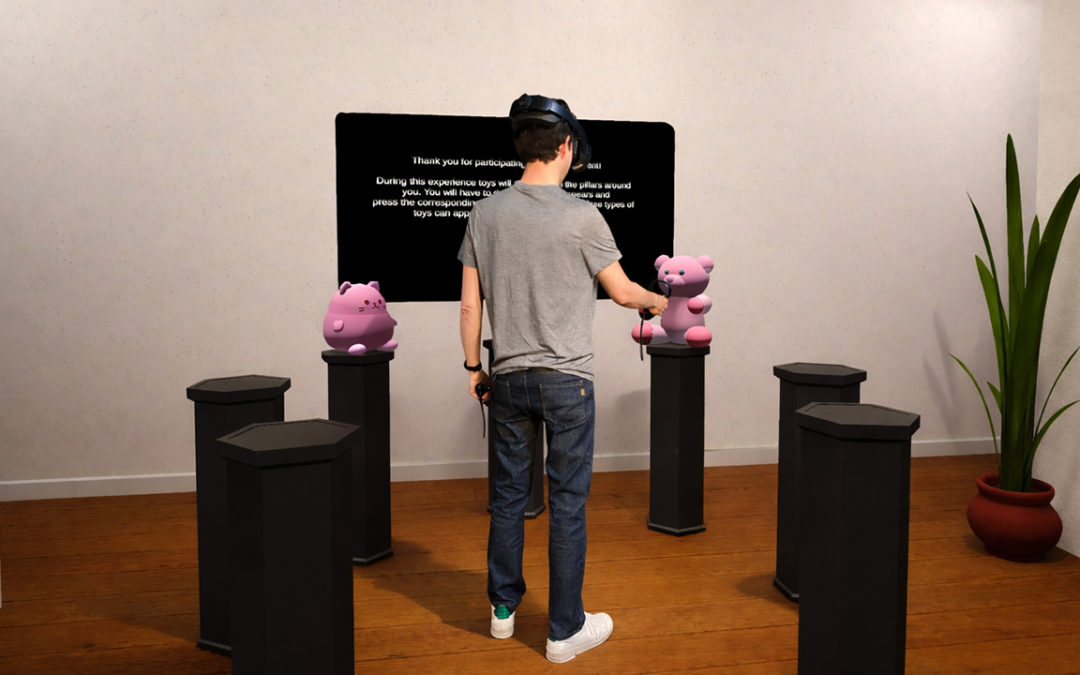
Attention and Curiosity play a key role in the guidance of behavior and skill acquisition. But how do you measure these processes, and how do they come together in a learning context? Can the controlled environment that VR enables play a role here? And what are the exact parameters for efficient learning?
These sorts of questions are what ABC-Space is all about. This SNSF-supported project which runs from 2024 to 2028, combines the expertise of LABNIC, TECFA and Artanim to try and find answers by exploring these concepts in three building blocks:
- Attention in 3D Space – how do we obtain reliable indices of attention in VR and a refined understanding of the underlying cognitive mechanisms?
- Curiosity in Naturalistic Environments – how do we measure how curiosity drives behavior and determine how it may boost or hamper memory in VR?
- Virtual social interaction through physics-based characters – how do more physically interactive characters offer a benefit to educational VR scenarios, and to what extent do their social cues affect spatial attention?
At Artanim, we focus on the development of physics-based controllers to control virtual reality characters and contribute to the design of behavioural experiments to validate their impact in terms of attention and learning. We further leverage our production expertise to create the VR environments and the characters within them to support the various studies.
More info: https://artanim.ch/project/abc-space
by artanim | Mar 18, 2026 | 3D animation, Virtual reality
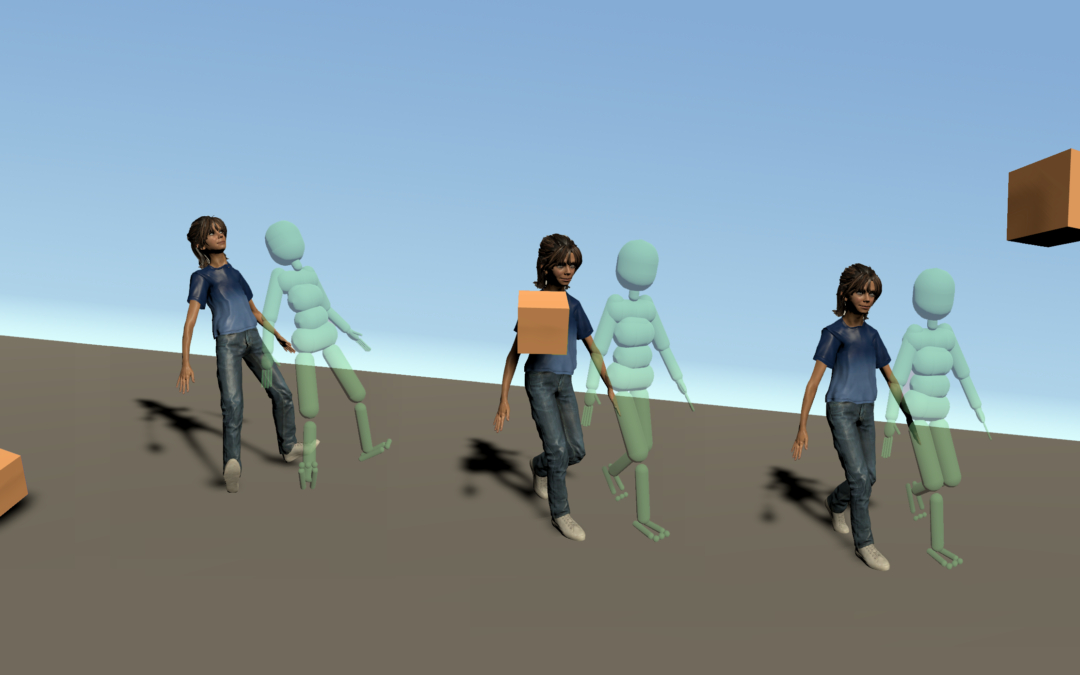
Imagine collaborating with someone on the other side of the world and feeling as if they were standing right next to you — sharing the same space, interacting with the same objects, communicating naturally.
This is the vision behind PRESENCE, a European research project running from 2024 to 2027, bringing together 17 partners across Europe to rethink how social presence works in extended reality (XR).
The project explores three key building blocks for the future of social XR:
- Ultra-realistic holoportation – capturing people volumetrically and bringing them into shared virtual environments as lifelike 3D representations
- Advanced haptics – enabling users to feel touch and physical interactions across virtual and real worlds
- Socially intelligent virtual humans – capable of generating interpersonal cues and interacting naturally with users
At Artanim, we focus on enabling physics-based control for autonomous virtual humans, allowing them to respond to body-centric behaviour and interact with elements in their environment.
By combining these technologies, PRESENCE aims to redefine what “being together at a distance” truly means — unlocking new possibilities for remote collaboration, training, culture, and social interaction in immersive environments.
More info: https://artanim.ch/project/presence/
by artanim | Jul 17, 2025 | 3D animation, Virtual reality
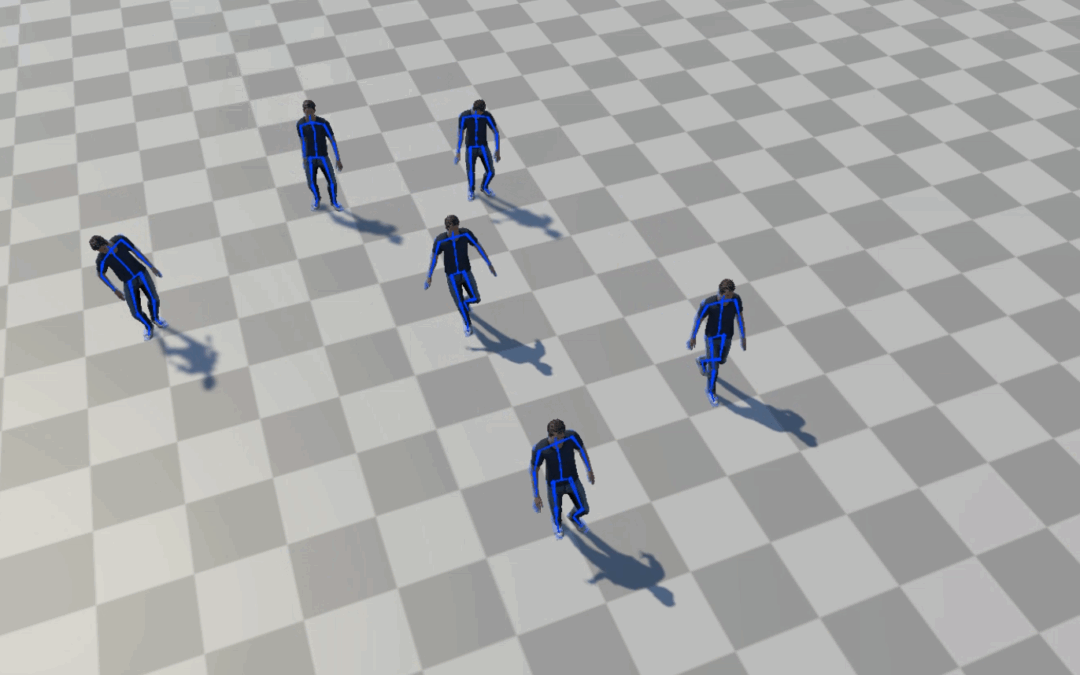
We rarely think about how we move. We just do it. However, creating a movement controller that matches our expectations is far more challenging than we would imagine (see Physics-based character animation and human motor control). Any roboticist will tell you. At Artanim we are exploring the use of movement controllers similar to the ones used to control robots, although doing so in physics simulations instead of in the real world. Our idea is that running these simulations in Virtual Reality (VR) will allow us to create characters with richer real-time reactivity. We believe this may be a step forward to improve the way autonomous virtual characters engage with their virtual environment, as well as a research path to provide characters that show lifelike behavior and some degree of nuanced interaction with VR users. Cognitive psychology and communication science has shown that people build rapport between them, in good part, through subtle behavioral cues, interpersonal coordination and loose but important rules relative to social space. Can we embed physics-based controllers with computational models that reproduce these mechanisms? (see Playing the mirror game in virtual reality with an autonomous character). What is the impact of implementing these computational models in VR experiences?
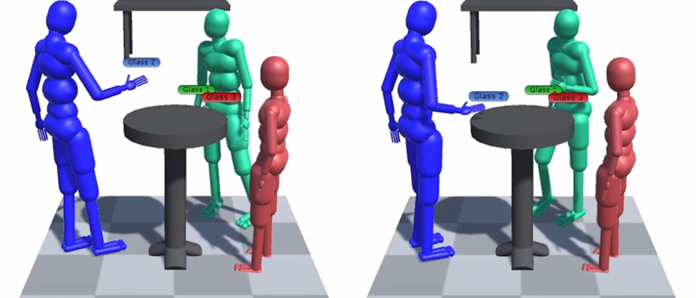
There are several technical challenges to address before we can explore questions related to interpersonal coordination and human-humanoid cooperation. The movement controllers need to be reliable, stable, solid, and easy to train, but also flexible enough to match the needs of a specific VR production scenario. Every day we engage with physical objects in rich and subtle ways: we grab a cup by its handle intuitively balancing it, use it to pour tea in it and drink it readapting dynamically to the movements of the liquid in it, then use the cup to push some object on the table, before leaving it there for a while. However, manipulating objects in tasks that require rich contacts is still a matter of fundamental research, in robotics and control theory. In addition, it is enough that we drink tea with someone else around for us to be willing to share the moment with them. We will change the dynamics involved in our gestures to show we take their interests and well-being into account. Can we create realistic social interactions among avatars and VR characters? This general question, focused specifically on body-centered interaction and interactive gestures, is what we are trying to answer in the EU Project PRESENCE.