Reverse Shoulder Prosthesis Simulation

Reverse Shoulder Prosthesis Simulation

Reverse Shoulder Prosthesis Simulation

A biomechanical simulation study evaluating implant configuration and shoulder range of motion.

Project Info

Start date

January 2017

End date

December 2017

Funding

Hirslanden Clinique La Colline

Coordinator

Artanim

Summary

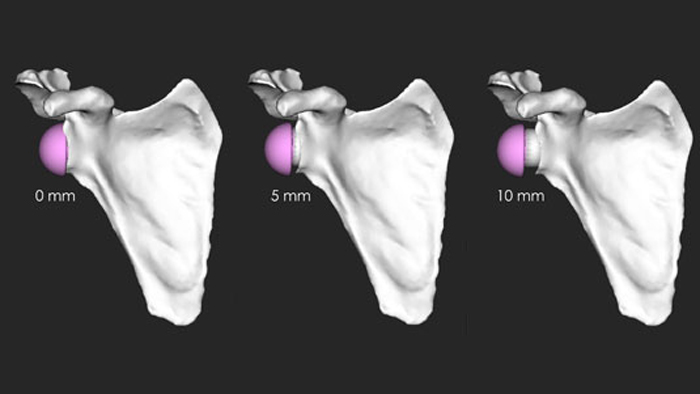
Reverse Shoulder Prosthesis Simulation investigates how different implant and anatomical parameters affect shoulder range of motion after reverse shoulder arthroplasty (RSA).

The study focuses in particular on glenoid lateralization, humeral inclination and critical shoulder angle (CSA), using computer-assisted simulations to evaluate their influence on joint mechanics and the risk of impingement or instability.

The objective is to identify surgical parameters that can help optimize implant configuration and reduce the risk of articular conflict and dislocation.

Within the project, Artanim was responsible for the dynamic simulation of reverse shoulder prostheses using kinematic data.

Partners

Artanim
Simulation of reverse shoulder prostheses.

Hirslanden Clinique La Colline – Center for Orthopaedic Surgery and Musculoskeletal Traumatology
Clinical testing and medical supervision.

Related Publications

Lädermann A, Tay E, Collin P, Piotton S, Chiu JCH, Michelet A, Charbonnier C. Effect of critical shoulder angle, glenoid lateralization and humeral inclination on range of motion in reverse shoulder arthroplasty, JSES Open Access, 3:240, 2019.
PDF · DOI

Lädermann A, Tay E, Collin P, Piotton S, Chiu JCH, Michelet A, Charbonnier C. Effect of critical shoulder angle, glenoid lateralization and humeral inclination on range of movement in reverse shoulder arthroplasty, Bone Joint Res, 8:378–386, 2019.
PDF · DOI

Charbonnier C, Tay E, Collin P, Piotton S, Chiu JCH, Michelet A, Lädermann A. Effect of critical shoulder angle, glenoid lateralization and humeral inclination on ROM in reverse shoulder arthroplasty, Swiss Med Wkly, 149(Suppl. 236):2S, 2019.
PDF
3D Proto

3D Proto

3D Proto

A virtual prototyping project improving sportswear fit through 3D simulation and body motion.

Project Info

Start date

November 2015

End date

December 2016

Funding

Commission for Technology and Innovation (CTI) – Project No. 18124.1 PFES-ES

Coordinator

Geneva University of Art and Design (HEAD)

Summary

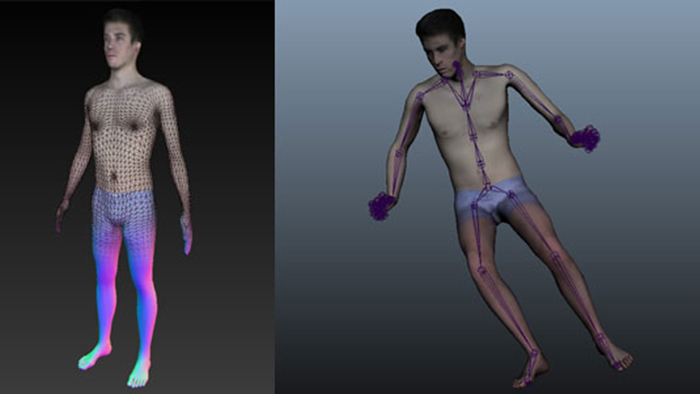
3D Proto investigates how virtual 3D prototyping can improve the design, fit and performance of technical sportswear. Detailed simulations provide quantitative information on how garments interact with the body, including areas of compression and deformation that are difficult to assess using conventional static prototypes.

The project focuses on improving garment prototyping workflows for the active sportswear sector by characterizing the physical and mechanical properties of technical fabrics and combining them with animated 3D body models. This allows sports garments to be simulated and evaluated under realistic movement conditions.

Within 3D Proto, Artanim provided realistic body animations for alpine skiing, Nordic skiing, running and hiking. Artanim also developed software tools to support fabric measurement protocols through the analysis of body motion and deformation.

Partners

Christiane Luible – Geneva University of Art and Design (HEAD)
Fabric characterization and 3D garment simulation.

Caecilia Charbonnier – Artanim
Motion capture, body modeling and animation, and development of software for body motion and garment deformation analysis.

Ulrike Froitzheim – Odlo International SA
3D garment design and industrial supervision.

Motion and Unconsciousness

Motion and Unconsciousness

Motion and Unconsciousness

A motion capture study investigating behavioral coordination and synchrony during social interaction.

Project Info

Start date

January 2013

End date

December 2016

Funding

Agalma Foundation

Coordinator

Agalma Foundation

Summary

Motion and Unconsciousness investigates how people coordinate their bodies during joint action and social interaction. The project focuses on the relationship between self and other representations, shared action and the behavioral mechanisms that contribute to the feeling of acting together.

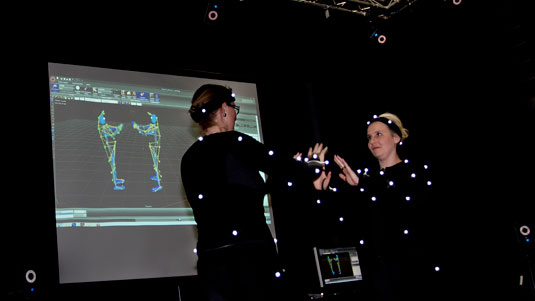
Motion capture was used to record pairs of participants performing joint-action and social-interaction tasks, allowing quantitative analysis of body posture, motor coordination, synchronization and nonverbal behavior.

These behavioral measurements were combined with respiratory coupling and dual electroencephalography (EEG) to investigate the bodily and neural mechanisms associated with interpersonal coordination and synchrony.

Partners

Agalma Foundation
Project coordination and experimental research framework.

Artanim
Motion capture, behavioral data processing and movement analysis.

University Hospitals of Geneva – Child and Adolescent Psychiatry
Experimental design and testing related to social interaction and interpersonal synchrony.

EPFL – Brain Mind Institute
Physiological data acquisition, including respiration and dual EEG.

Related Publications

Preissmann D, Charbonnier C, Chagué S, Antonietti JP, Llobera J, Ansermet F, Magistretti PJ. A motion capture study to measure the feeling of synchrony in romantic couples and in professional musicians, Front Psychol, 7:1673, 2016.
PDF · DOI

Llobera J, Charbonnier C, Chagué S, Preissmann D, Antonietti JP, Ansermet F, Magistretti P. The Subjective Sensation of Synchrony: An Experimental Study, PLoS ONE, 11(2):e0147008, 2016.
PDF · DOI

ArthroPlanner

ArthroPlanner

ArthroPlanner

A 3D surgical planning platform integrating patient-specific anatomy and joint kinematics.

Project Info

Start date

November 2014

End date

October 2016

Funding

Private foundation

Coordinator

Artanim

Summary

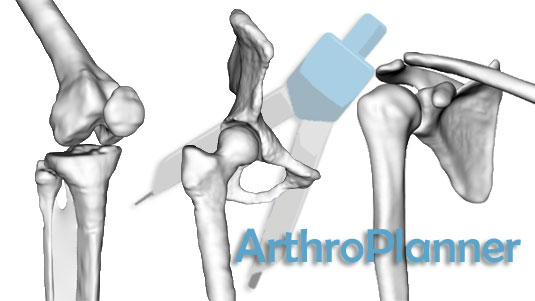
ArthroPlanner aimed to develop patient-specific surgical planning tools that combine 3D anatomy with functional joint kinematics. Building on Artanim’s previous research in medical imaging, motion capture and biomechanical simulation, the project explored how dynamic information could complement conventional static anatomical planning and support more personalized clinical decision-making.

A major application focused on shoulder surgery and the development of a computer-assisted planning solution for acromioplasty. Patient-specific 3D anatomical models and joint simulations were used to identify areas of subacromial impingement and estimate the bone resection required during surgery. This approach was subsequently evaluated through clinical studies comparing planned and actual resections as well as guided and conventional freehand acromioplasty.

A similar planning solution was developed for femoroacetabular impingement (FAI) of the hip. Patient-specific 3D models and joint simulations were used to identify impingement zones during movement and to support planning of the bone resection required to restore functional range of motion. Unlike the acromioplasty application, this hip planning solution was not clinically evaluated.

The project also extended these patient-specific modeling techniques to the knee. Motion capture, magnetic resonance imaging and biomechanical optimization were combined to improve the estimation of knee kinematics at high flexion angles and to analyze structures such as the posterior cruciate ligament during static and dynamic movements.

More broadly, ArthroPlanner contributed to Artanim’s research toward dynamic surgical planning solutions for the hip, shoulder and knee, integrating patient-specific anatomy and movement into clinically relevant 3D tools.

Related Publications

Lädermann A, Chagué S, Preissmann D, Kolo FC, Zbinden O, Kevelham B, Bothorel H, Charbonnier C. Acromioplasty during repair of rotator cuff tears removes only half of the impinging acromial bone, JSES Int, 4(3):592-600, 2020.
PDF · DOI

Lädermann A, Chagué S, Preissmann D, Kolo FC, Rime O, Kevelham B, Bothorel H, Charbonnier C. Guided versus Freehand acromioplasty during rotator cuff repair. A randomized prospective study, Orthop Traumatol Surg Res, 106(4):651-659, 2020.
PDF · DOI

Lädermann A, Chagué S, Preissmann D, Kolo FC, Rime O, Kevelham B, Bothorel H, Charbonnier C. L’acromioplastie guidée comparée à l’acromioplastie à main levée dans la réparation de la coiffe des rotateurs. Une étude prospective randomisée, Revue de chirurgie orthopédique et traumatologique, 106(4):372-380, 2020.
PDF · DOI

Charbonnier C, Duthon VB, Chagué S, Kolo FC, Ménétrey J. In Vivo Static and Dynamic Lengthening Measurements of the Posterior Cruciate Ligament at High Knee Flexion Angles, Int J CARS, 15(3):555-564, 2020.
PDF · DOI

Charbonnier C, Chagué S, Kevelham B, Preissmann D, Kolo FC, Rime O, Lädermann A. ArthroPlanner: A Surgical Planning Solution for Acromioplasty, Int J CARS, 13(12):2009-2019, 2018.
PDF · DOI

Charbonnier C, Chagué S, Kolo FC, Duthon VB, Menetrey J. Multi-body Optimization with Subject-Specific Knee Models: Performance at High Knee Flexion Angles, Comput Meth Biomech Biomed Eng, 20(14):1571-1579, 2017.
PDF · DOI

Lädermann A, Kolo FC, Chagué S, Charbonnier C. Is acromioplasty planification useful? A prospective randomized trial, XIVe Congrès de la Société Francophone d’Arthroscopie, Paris, France, Revue de chirurgie orthopédique et traumatologique, 103(8):S268, September 2017.
PDF · DOI

Charbonnier C, Kolo FC, Lädermann A. Acromioplasty Planification: A Randomized Prospective Study, 27th Annual Congress of the European Shoulder and Elbow Society (SECEC), Berlin, Germany, September 2017.
PDF

Charbonnier C, Chagué S, Kevelham B, Kolo FC, Lädermann A. ArthroPlanner: A Surgical Planning Solution for Acromioplasty, 30th International Congress of Computer Assisted Radiology and Surgery, Heidelberg, Germany, Int J CARS, June 2016.
PDF

Shoulder Instability

Shoulder Instability

Shoulder Instability

A motion capture study assessing shoulder kinematics before and after surgery for anterior instability.

Project Info

Start date

August 2014

End date

July 2016

Funding

FORE Foundation / La Tour Hospital

Coordinator

Artanim

Summary

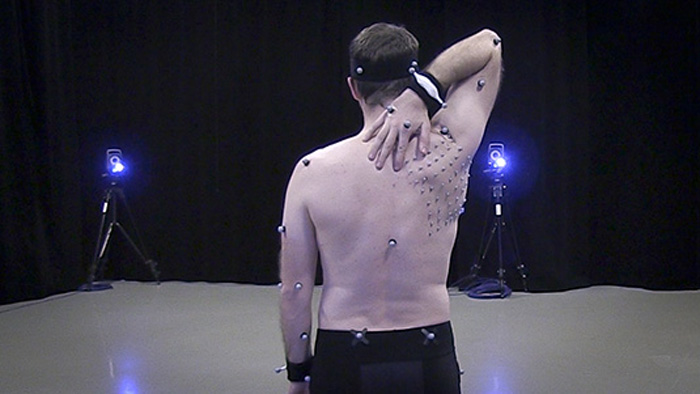
Anterior shoulder instability is a common condition in young and athletic adults and can lead to recurrent dislocations or subluxations. When instability becomes recurrent, surgical treatment may be required. Beyond preventing further dislocation, an important question is whether surgery also restores normal shoulder mechanics and joint stability during movement.

This study investigated shoulder kinematics in patients with anterior instability using dynamic motion capture before and after surgical treatment. By comparing joint motion pre- and post-operatively, the project aimed to better characterize the biomechanical effects of instability and assess how surgical treatment influences shoulder stability and movement.

Partners

Artanim
Patient-specific shoulder modeling, motion analysis and biomechanical simulation.

La Tour Hospital – Elbow & Shoulder Orthopedics and Traumatology
Clinical evaluation and medical supervision.

Imaging Center Rive Droite SA
Radiological imaging acquisitions.

Related Publications

Elsenbsy A, Charbonnier C, Juillard V, Chagué S, Zbinden J, Collin P, Ahmed M, Tammam H, Said E, Lädermann A. Capsular Repair Matters for Residual Micromotion After Latarjet. An Externally Controlled Trial from the LaTour Group, HMSJ, 2(1), 2026.
PDF · DOI

Collin P, Charbonnier C, Chagué S, Lädermann A. La réparation capsulaire est-elle importante pour le micromouvement résiduel après Latarjet. Essai prospectif contrôlé en externe., 17ème Congrès national de médecine et traumatologie du sport (SFTS), Beffroi de Montrouge, France, June, 2024.
PDF

Lädermann A, Collin P, Chagué S, Charbonnier C. Does capsular repair matter for residual micromotion after Latarjet? A prospective and externally controlled trial, Rev Chir Orthop Traumatol, 109(8):S346, 2023.
PDF · DOI

Lädermann A, Denard PJ, Tirefort J, Chagué S, Cunningham G, Charbonnier C. Est-ce que les stabilisations d’épaule stabilisent les épaules ?, Congrès de la Société Francophone d’Arthroscopie 2016, Paris, France, Rev Chir Orthop Traumatol, 102(8):S284-S285, December, 2016.
PDF · DOI

Lädermann A, Denard PJ, Tirefort J, Kolo FC, Chagué S, Cunningham G, Charbonnier C. Does Surgery for Instability of the Shoulder Truly Stabilize the Glenohumeral Joint? A Prospective Comparative Cohort Study, Medicine (Baltimore), 95(31):e4369, 2016.
PDF · DOI

Lädermann A, Charbonnier C. Kinematics of the Shoulder Joint, Leading Opinions, 2015.
PDF