3D Proto

3D Proto

3D Proto

A virtual prototyping project improving sportswear fit through 3D simulation and body motion.

Project Info

Start date

November 2015

End date

December 2016

Funding

Commission for Technology and Innovation (CTI) – Project No. 18124.1 PFES-ES

Coordinator

Geneva University of Art and Design (HEAD)

Summary

3D Proto investigates how virtual 3D prototyping can improve the design, fit and performance of technical sportswear. Detailed simulations provide quantitative information on how garments interact with the body, including areas of compression and deformation that are difficult to assess using conventional static prototypes.

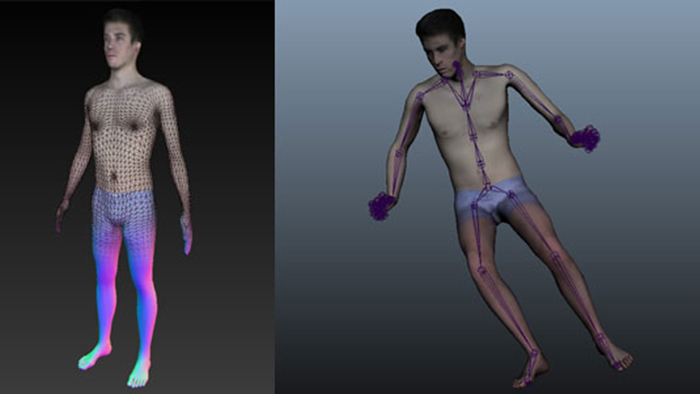
The project focuses on improving garment prototyping workflows for the active sportswear sector by characterizing the physical and mechanical properties of technical fabrics and combining them with animated 3D body models. This allows sports garments to be simulated and evaluated under realistic movement conditions.

Within 3D Proto, Artanim provided realistic body animations for alpine skiing, Nordic skiing, running and hiking. Artanim also developed software tools to support fabric measurement protocols through the analysis of body motion and deformation.

Partners

Christiane Luible – Geneva University of Art and Design (HEAD)
Fabric characterization and 3D garment simulation.

Caecilia Charbonnier – Artanim
Motion capture, body modeling and animation, and development of software for body motion and garment deformation analysis.

Ulrike Froitzheim – Odlo International SA
3D garment design and industrial supervision.
Fashioning Movement

Fashioning Movement

Fashioning Movement

A research project exploring garment comfort and fit through animated 3D body simulation.

Project Info

Start date

November 2013

End date

October 2015

Funding

HES-SO

Coordinator

Geneva University of Art and Design (HEAD)

Summary

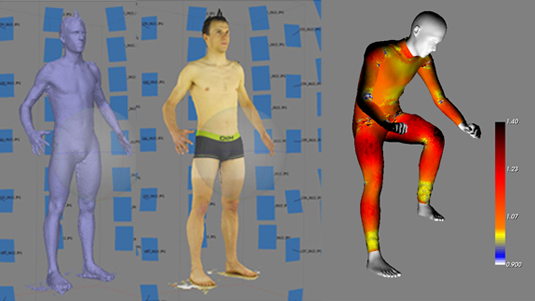
Fashioning Movement investigated how body movement affects garment comfort and fit. While conventional garment evaluation is largely based on static postures and subjective assessment, the project explored how animated 3D body models and garment simulation could provide objective, quantitative information on the interaction between the body, fabric and clothing during movement.

The research combined body motion with 3D garment simulation to analyze garment deformation and fit under dynamic conditions. The resulting numerical data provided new ways to evaluate comfort and supported the exploration of garment design and pattern-making methods that take movement into account from the early stages of development.

A pilot project was developed within this research to demonstrate the approach in practice. View the pilot project.

Partners

Geneva University of Art and Design (HEAD)
3D garment design and simulation.

Artanim
Motion capture, body modeling and animation, and development of software for garment deformation analysis.

Collaborators
Odlo International, Salomon and Empa – Swiss Federal Laboratories for Materials Science and Technology.

Related Publications

Mert E, Psikuta A, Joshi A, Arevalo M, Charbonnier C, Luible-Bär C, Annaheim S, Rossi R. The distribution of air gap thickness and the contact area during Alpine skiing, Proc. of 9th Int. Conf. on 3D Body Scanning Technologies, Lugano, Switzerland, October, 2018.
PDF · DOI

Mert E, Psikuta A, Arevalo M, Charbonnier C, Luible-Bär C, Bueno MA, Rossi R. A validation methodology and application of 3D garment simulation software to determine the distribution of air layers in garments during walking, Measurement, 117:153-164, 2018.
PDF · DOI

Luible C, Charbonnier C. Fashioning Movement: a new approach to Fashion Design, In Unfrozen – Design Research Today, Edited by Swiss Design Network, Triest Verlag, 2017.
PDF

Mert E, Psikuta A, Arevalo M, Charbonnier C, Luible C, Bueno MA, Rossi RM. Quantitative validation of 3D garment simulation software for determination of air gap thickness in lower body garments, IOP Conf. Series: Materials Science and Engineering, 254(16):162007, 2017.
PDF · DOI

Mert E, Psikuta A, Arevalo M, Charbonnier C, Luible C, Bueno MA, Rossi RM. Quantitative validation of 3D garment simulation software for determination of air gap thickness in lower body garments, AUTEX World Textile Conference, Corfu, Greece, May, 2017.

Luible C, Charbonnier C. Fashioning Movement: a new approach to Fashion Design, Unfrozen Symposium, 1st SDN Design Research Winter Summit, Giessbach, Switzerland, January, 2016.
PDF

Shoulder Rehabilitation

Shoulder Rehabilitation

Shoulder Rehabilitation

A biomechanical study evaluating shoulder rehabilitation exercises through motion capture and simulation.

Project Info

Start date

April 2014

End date

December 2014

Funding

University Hospitals of Geneva (HUG)

Coordinator

Artanim

Summary

Shoulder Rehabilitation investigated how different strengthening exercises affect the glenohumeral joint and rotator cuff. In patients with rotator cuff lesions, cartilage disorders or shoulder instability, rehabilitation programs aim to strengthen the shoulder while limiting subacromial impingement and excessive stress on the cartilage, labrum and tendons.

The study used motion capture and biomechanical simulation to analyze 30 to 50 rehabilitation exercises. The objective was to quantify their effects on the glenohumeral joint, including cartilage compression and subacromial impingement, as well as on rotator cuff mechanics through changes in tendon length of the subscapularis, supraspinatus, infraspinatus and teres minor.

By providing objective biomechanical data on commonly used exercises, the project aimed to support more informed selection of shoulder rehabilitation protocols.

Partners

Artanim
Patient-specific shoulder modeling, motion analysis and biomechanical simulation.

University Hospitals of Geneva – Physical Medicine and Orthopedic Rehabilitation Unit
Selection and clinical evaluation of rehabilitation exercises.

University Hospitals of Geneva – Division of Orthopaedic Surgery and Traumatology
Medical supervision and clinical expertise.

Related Publications

Charbonnier C, Lädermann A, Kevelham B, Chagué S, Hoffmeyer P, Holzer N. Shoulder Strengthening Exercises Adapted to Specific Shoulder Pathologies Can Be Selected Using New Simulation Techniques: A Pilot Study, Int J Comput Assist Radiol Surg, 13(2):321-330, 2018.
PDF · DOI

Charbonnier C, Chagué S, Lädermann A, Holzer N. Évaluation des effets potentiellement délétères d’exercices de l’épaule en fonction des pathologies rencontrées, Congrès de la Société Francophone d’Arthroscopie 2016, Paris, France, Rev Chir Orthop Traumatol, 102(8):S307, December, 2016.
PDF · DOI

Holzer N, Chagué S, Lädermann A, Ziltener JL, Hoffmeyer P, Charbonnier C. High differences in subacromial space height and gleno-humeral compression according to shoulder muscle exercise type, Swiss Med Wkly, Suppl. 210, 145:32S, 2015.
PDF

Charbonnier C, Kevelham B, Chagué S, Lädermann A, Ziltener JL, Hoffmeyer P, Holzer N. Impact of Shoulder Strengthening Exercises on the Shoulder Joint, 33rd International Conference on Biomechanics in Sports, Poitiers, France, June, 2015.
PDF

Charbonnier C, Kevelham B, Chagué S, Lädermann A, Ziltener JL, Hoffmeyer P, Holzer N. A Simplified Technique To Estimate Rotator Cuff Elongation During Complex Shoulder Motion, 29th International Congress of Computer Assisted Radiology and Surgery, Barcelona, Spain, Int J Comput Assist Radiol Surg, June, 2015.
PDF · DOI

Holzer N, Chagué S, Lädermann A, Ziltener JL, Hoffmeyer P, Charbonnier C. Impact of Shoulder Strengthening Exercises on Subacromial Space Height and on Articular Cartilages and Labrum Compression Using Motion Capture Analysis, 16th EFORT Congress, Prague, Czech Republic, June, 2015.
PDF

Shoulder3D

Shoulder3D

Shoulder3D

A motion capture project developing a patient-specific 3D kinematic model of the shoulder complex.

Project Info

Start date

June 2012

End date

March 2014

Funding

La Tour Hospital / European Society of Shoulder and Elbow Surgery

Coordinator

Artanim

Summary

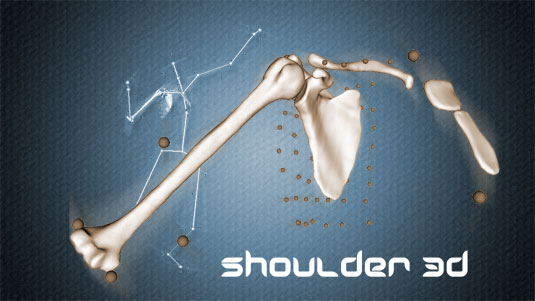
Shoulder3D aimed to develop a reliable three-dimensional kinematic model of the shoulder complex based on motion capture. Because the shoulder combines an exceptionally large range of motion with limited intrinsic stability, accurate analysis of its movement is important for understanding the mechanisms involved in shoulder function and dysfunction.

The project combined motion capture with patient-specific anatomical modeling to evaluate shoulder motion in three dimensions. The model was developed and assessed through a clinical study involving tennis players, providing a framework for analyzing joint kinematics during complex upper-limb movements.

The resulting approach opened new possibilities for the functional assessment of shoulder disorders and for supporting clinical decision-making in the diagnosis and treatment of patients with shoulder abnormalities.

Partners

Artanim
Patient-specific shoulder modeling, motion analysis and biomechanical simulation.

La Tour Hospital – Elbow & Shoulder Orthopedics and Traumatology
Clinical evaluation and medical supervision.

Imaging Center Rive Droite SA
Radiological imaging acquisitions.

Related Publications

Lädermann A, Bonnevialle N, Charbonnier C. The Shoulder in Tennis: The Different Types of Impingement & Instability, In Shoulder Concepts 2016 – Arthroscopy, Arthroplasty & Fractures, Edited by P. Boileau Sauramps Medical Montpellier, 2016.
PDF

Lädermann A, Chagué S, Kolo FC, Charbonnier C. Kinematics of the Shoulder Joint in Tennis Players, J Sci Med Sport, 19(1):56-63, 2016.
PDF · DOI

Charbonnier C, Chagué S, Kolo FC, Lädermann A. Shoulder Motion During Tennis Serve: Dynamic and Radiological Evaluation Based on Motion Capture and Magnetic Resonance Imaging, Int J Comput Assist Radiol Surg, 10(8):1289-1297, 2015.
PDF · DOI

Charbonnier C, Chagué S, Kolo FC, Chow JCK, Lädermann A. Évaluation personnalisée de l’épaule par modélisation de la cinétique articulaire, Rev Chir Orthop Traumatol, 100(7):521, 2014.
PDF · DOI

Charbonnier C, Chagué S, Kolo FC, Chow JCK, Lädermann A. A Patient-Specific Measurement Technique to Model Shoulder Joint Kinematics, Orthop Traumatol Surg Res, 100(7):715-719, 2014.
PDF · DOI

Lädermann A, Chagué S, Kolo FC, Charbonnier C. Kinematic of the Shoulder Joints in Professional Tennis Players, Swiss Med Wkly, Suppl. 204, 144:14S, 2014.
PDF

Charbonnier C, Chagué S, Kolo FC, Lädermann A. A Patient-Specific Measurement Technique to Model the Kinematics of the Shoulder in Tennis Players, 14th Annual Meeting of the International Society for Computer Assisted Orthopaedic Surgery (CAOS), Milan, Italy, June, 2014.
PDF

Charbonnier C, Chagué S, Kolo FC, Lädermann A. Analysis of Shoulder Impingement and Stability in Tennis Players, Proceedings of the 13th International Symposium on 3D Analysis of Human Movement, Lausanne, Switzerland, July, 2014.
PDF

Lädermann A, Chagué S, Kolo FC, Charbonnier C. Kinematic Modeling of the Shoulder in Tennis Players, 24th Annual Congress of the European Shoulder and Elbow Society (SECEC), Madrid, Spain, September, 2013.

Award