ArthroPlanner

ArthroPlanner

ArthroPlanner

A 3D surgical planning platform integrating patient-specific anatomy and joint kinematics.

Project Info

Start date

November 2014

End date

October 2016

Funding

Private foundation

Coordinator

Artanim

Summary

ArthroPlanner aimed to develop patient-specific surgical planning tools that combine 3D anatomy with functional joint kinematics. Building on Artanim’s previous research in medical imaging, motion capture and biomechanical simulation, the project explored how dynamic information could complement conventional static anatomical planning and support more personalized clinical decision-making.

A major application focused on shoulder surgery and the development of a computer-assisted planning solution for acromioplasty. Patient-specific 3D anatomical models and joint simulations were used to identify areas of subacromial impingement and estimate the bone resection required during surgery. This approach was subsequently evaluated through clinical studies comparing planned and actual resections as well as guided and conventional freehand acromioplasty.

A similar planning solution was developed for femoroacetabular impingement (FAI) of the hip. Patient-specific 3D models and joint simulations were used to identify impingement zones during movement and to support planning of the bone resection required to restore functional range of motion. Unlike the acromioplasty application, this hip planning solution was not clinically evaluated.

The project also extended these patient-specific modeling techniques to the knee. Motion capture, magnetic resonance imaging and biomechanical optimization were combined to improve the estimation of knee kinematics at high flexion angles and to analyze structures such as the posterior cruciate ligament during static and dynamic movements.

More broadly, ArthroPlanner contributed to Artanim’s research toward dynamic surgical planning solutions for the hip, shoulder and knee, integrating patient-specific anatomy and movement into clinically relevant 3D tools.

Related Publications

Lädermann A, Chagué S, Preissmann D, Kolo FC, Zbinden O, Kevelham B, Bothorel H, Charbonnier C. Acromioplasty during repair of rotator cuff tears removes only half of the impinging acromial bone, JSES Int, 4(3):592-600, 2020.
PDF · DOI

Lädermann A, Chagué S, Preissmann D, Kolo FC, Rime O, Kevelham B, Bothorel H, Charbonnier C. Guided versus Freehand acromioplasty during rotator cuff repair. A randomized prospective study, Orthop Traumatol Surg Res, 106(4):651-659, 2020.
PDF · DOI

Lädermann A, Chagué S, Preissmann D, Kolo FC, Rime O, Kevelham B, Bothorel H, Charbonnier C. L’acromioplastie guidée comparée à l’acromioplastie à main levée dans la réparation de la coiffe des rotateurs. Une étude prospective randomisée, Revue de chirurgie orthopédique et traumatologique, 106(4):372-380, 2020.
PDF · DOI

Charbonnier C, Duthon VB, Chagué S, Kolo FC, Ménétrey J. In Vivo Static and Dynamic Lengthening Measurements of the Posterior Cruciate Ligament at High Knee Flexion Angles, Int J CARS, 15(3):555-564, 2020.
PDF · DOI

Charbonnier C, Chagué S, Kevelham B, Preissmann D, Kolo FC, Rime O, Lädermann A. ArthroPlanner: A Surgical Planning Solution for Acromioplasty, Int J CARS, 13(12):2009-2019, 2018.
PDF · DOI

Charbonnier C, Chagué S, Kolo FC, Duthon VB, Menetrey J. Multi-body Optimization with Subject-Specific Knee Models: Performance at High Knee Flexion Angles, Comput Meth Biomech Biomed Eng, 20(14):1571-1579, 2017.
PDF · DOI

Lädermann A, Kolo FC, Chagué S, Charbonnier C. Is acromioplasty planification useful? A prospective randomized trial, XIVe Congrès de la Société Francophone d’Arthroscopie, Paris, France, Revue de chirurgie orthopédique et traumatologique, 103(8):S268, September 2017.
PDF · DOI

Charbonnier C, Kolo FC, Lädermann A. Acromioplasty Planification: A Randomized Prospective Study, 27th Annual Congress of the European Shoulder and Elbow Society (SECEC), Berlin, Germany, September 2017.
PDF

Charbonnier C, Chagué S, Kevelham B, Kolo FC, Lädermann A. ArthroPlanner: A Surgical Planning Solution for Acromioplasty, 30th International Congress of Computer Assisted Radiology and Surgery, Heidelberg, Germany, Int J CARS, June 2016.
PDF
Shoulder Instability

Shoulder Instability

Shoulder Instability

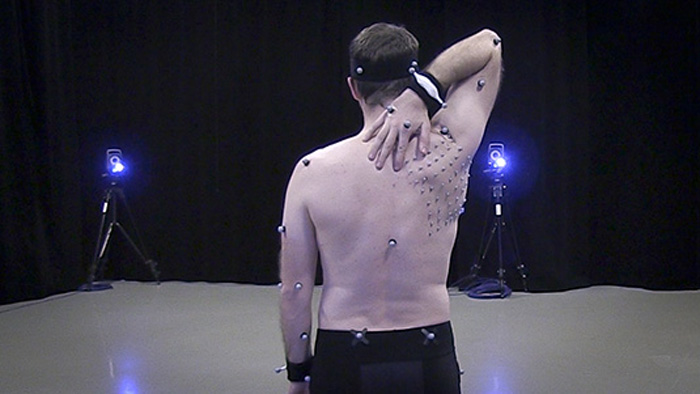
A motion capture study assessing shoulder kinematics before and after surgery for anterior instability.

Project Info

Start date

August 2014

End date

July 2016

Funding

FORE Foundation / La Tour Hospital

Coordinator

Artanim

Summary

Anterior shoulder instability is a common condition in young and athletic adults and can lead to recurrent dislocations or subluxations. When instability becomes recurrent, surgical treatment may be required. Beyond preventing further dislocation, an important question is whether surgery also restores normal shoulder mechanics and joint stability during movement.

This study investigated shoulder kinematics in patients with anterior instability using dynamic motion capture before and after surgical treatment. By comparing joint motion pre- and post-operatively, the project aimed to better characterize the biomechanical effects of instability and assess how surgical treatment influences shoulder stability and movement.

Partners

Artanim
Patient-specific shoulder modeling, motion analysis and biomechanical simulation.

La Tour Hospital – Elbow & Shoulder Orthopedics and Traumatology
Clinical evaluation and medical supervision.

Imaging Center Rive Droite SA
Radiological imaging acquisitions.

Related Publications

Elsenbsy A, Charbonnier C, Juillard V, Chagué S, Zbinden J, Collin P, Ahmed M, Tammam H, Said E, Lädermann A. Capsular Repair Matters for Residual Micromotion After Latarjet. An Externally Controlled Trial from the LaTour Group, HMSJ, 2(1), 2026.
PDF · DOI

Collin P, Charbonnier C, Chagué S, Lädermann A. La réparation capsulaire est-elle importante pour le micromouvement résiduel après Latarjet. Essai prospectif contrôlé en externe., 17ème Congrès national de médecine et traumatologie du sport (SFTS), Beffroi de Montrouge, France, June, 2024.
PDF

Lädermann A, Collin P, Chagué S, Charbonnier C. Does capsular repair matter for residual micromotion after Latarjet? A prospective and externally controlled trial, Rev Chir Orthop Traumatol, 109(8):S346, 2023.
PDF · DOI

Lädermann A, Denard PJ, Tirefort J, Chagué S, Cunningham G, Charbonnier C. Est-ce que les stabilisations d’épaule stabilisent les épaules ?, Congrès de la Société Francophone d’Arthroscopie 2016, Paris, France, Rev Chir Orthop Traumatol, 102(8):S284-S285, December, 2016.
PDF · DOI

Lädermann A, Denard PJ, Tirefort J, Kolo FC, Chagué S, Cunningham G, Charbonnier C. Does Surgery for Instability of the Shoulder Truly Stabilize the Glenohumeral Joint? A Prospective Comparative Cohort Study, Medicine (Baltimore), 95(31):e4369, 2016.
PDF · DOI

Lädermann A, Charbonnier C. Kinematics of the Shoulder Joint, Leading Opinions, 2015.
PDF

To Fit

To Fit

To Fit

A 3D body digitization project combining head and body scans into a complete animatable avatar.

Project Info

Start date

June 2014

End date

April 2015

Funding

ToFit Sàrl

Coordinator

Artanim

Summary

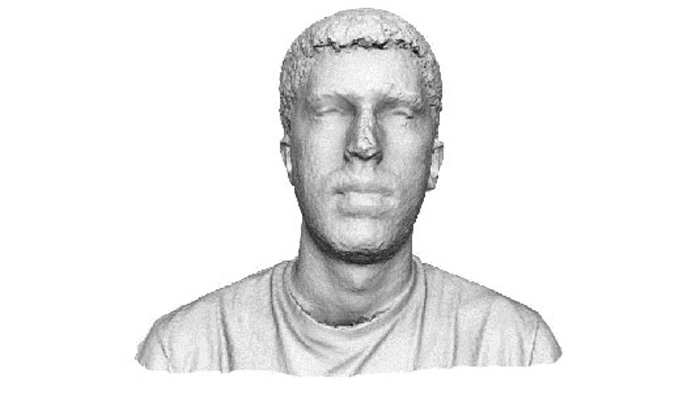
ToFit aimed to create a complete 3D avatar of a user by combining head and body scans acquired with different scanning technologies. A first part of the project focused on developing an affordable multi-camera system capable of producing high-quality textured head scans, with sufficient visual fidelity to achieve a convincing representation of the user.

The second part focused on merging the head scan with full-body scan data using template fitting. This process enabled the generation of a unified 3D body model, the extraction of body measurements and the automatic creation of an internal skeleton for animation.

Thoracic Outlet Syndrome

Thoracic Outlet Syndrome

Thoracic Outlet Syndrome

A motion capture and medical imaging study investigating shoulder mechanics in thoracic outlet syndrome.

Project Info

Start date

March 2014

End date

December 2014

Funding

FORE Foundation / La Tour Hospital

Coordinator

Artanim

Summary

Thoracic Outlet Syndrome investigated the biomechanical mechanisms that may contribute to thoracic outlet syndrome (TOS), a condition associated with compression of nerves or blood vessels in the region between the clavicle and upper rib cage.

The study focused on dynamic analysis of the shoulder complex to better understand how repetitive arm movements and individual anatomy may influence this compression. Motion capture was combined with medical imaging, including CT and MRI, to reconstruct patient-specific anatomy and analyze shoulder movement in symptomatic patients.

By integrating anatomical and kinematic information, the project aimed to improve the functional assessment of TOS and provide a better understanding of the relationship between shoulder motion and structures involved in the thoracic outlet.

Partners

Artanim
Patient-specific shoulder modeling, motion analysis and biomechanical simulation.

La Tour Hospital – Elbow & Shoulder Orthopedics and Traumatology
Clinical evaluation and medical supervision.

Imaging Center Rive Droite SA
Radiological imaging acquisitions.

Shoulder3D

Shoulder3D

Shoulder3D

A motion capture project developing a patient-specific 3D kinematic model of the shoulder complex.

Project Info

Start date

June 2012

End date

March 2014

Funding

La Tour Hospital / European Society of Shoulder and Elbow Surgery

Coordinator

Artanim

Summary

Shoulder3D aimed to develop a reliable three-dimensional kinematic model of the shoulder complex based on motion capture. Because the shoulder combines an exceptionally large range of motion with limited intrinsic stability, accurate analysis of its movement is important for understanding the mechanisms involved in shoulder function and dysfunction.

The project combined motion capture with patient-specific anatomical modeling to evaluate shoulder motion in three dimensions. The model was developed and assessed through a clinical study involving tennis players, providing a framework for analyzing joint kinematics during complex upper-limb movements.

The resulting approach opened new possibilities for the functional assessment of shoulder disorders and for supporting clinical decision-making in the diagnosis and treatment of patients with shoulder abnormalities.

Partners

Artanim
Patient-specific shoulder modeling, motion analysis and biomechanical simulation.

La Tour Hospital – Elbow & Shoulder Orthopedics and Traumatology
Clinical evaluation and medical supervision.

Imaging Center Rive Droite SA
Radiological imaging acquisitions.

Related Publications

Lädermann A, Bonnevialle N, Charbonnier C. The Shoulder in Tennis: The Different Types of Impingement & Instability, In Shoulder Concepts 2016 – Arthroscopy, Arthroplasty & Fractures, Edited by P. Boileau Sauramps Medical Montpellier, 2016.
PDF

Lädermann A, Chagué S, Kolo FC, Charbonnier C. Kinematics of the Shoulder Joint in Tennis Players, J Sci Med Sport, 19(1):56-63, 2016.
PDF · DOI

Charbonnier C, Chagué S, Kolo FC, Lädermann A. Shoulder Motion During Tennis Serve: Dynamic and Radiological Evaluation Based on Motion Capture and Magnetic Resonance Imaging, Int J Comput Assist Radiol Surg, 10(8):1289-1297, 2015.
PDF · DOI

Charbonnier C, Chagué S, Kolo FC, Chow JCK, Lädermann A. Évaluation personnalisée de l’épaule par modélisation de la cinétique articulaire, Rev Chir Orthop Traumatol, 100(7):521, 2014.
PDF · DOI

Charbonnier C, Chagué S, Kolo FC, Chow JCK, Lädermann A. A Patient-Specific Measurement Technique to Model Shoulder Joint Kinematics, Orthop Traumatol Surg Res, 100(7):715-719, 2014.
PDF · DOI

Lädermann A, Chagué S, Kolo FC, Charbonnier C. Kinematic of the Shoulder Joints in Professional Tennis Players, Swiss Med Wkly, Suppl. 204, 144:14S, 2014.
PDF

Charbonnier C, Chagué S, Kolo FC, Lädermann A. A Patient-Specific Measurement Technique to Model the Kinematics of the Shoulder in Tennis Players, 14th Annual Meeting of the International Society for Computer Assisted Orthopaedic Surgery (CAOS), Milan, Italy, June, 2014.
PDF

Charbonnier C, Chagué S, Kolo FC, Lädermann A. Analysis of Shoulder Impingement and Stability in Tennis Players, Proceedings of the 13th International Symposium on 3D Analysis of Human Movement, Lausanne, Switzerland, July, 2014.
PDF

Lädermann A, Chagué S, Kolo FC, Charbonnier C. Kinematic Modeling of the Shoulder in Tennis Players, 24th Annual Congress of the European Shoulder and Elbow Society (SECEC), Madrid, Spain, September, 2013.

Award