XRay

XRay

XRay

An AR testbed combining real-time markerless motion capture with in-situ movement visualization.

Project Info

Start date

June 2026

End date

Funding

Artanim

Coordinator

Artanim

Summary

Beyond entertainment, motion capture has become a valuable tool in fields such as sports science, robotics, ergonomics and healthcare. In clinical settings, however, marker-based motion capture can remain cumbersome: preparing a patient with markers takes time and may limit its practical use for routine assessment.

This is where real-time markerless motion capture offers significant advantages. Patients can be tracked with minimal preparation and, in many cases, in their everyday clothing, making movement assessment faster and easier to integrate into clinical workflows.

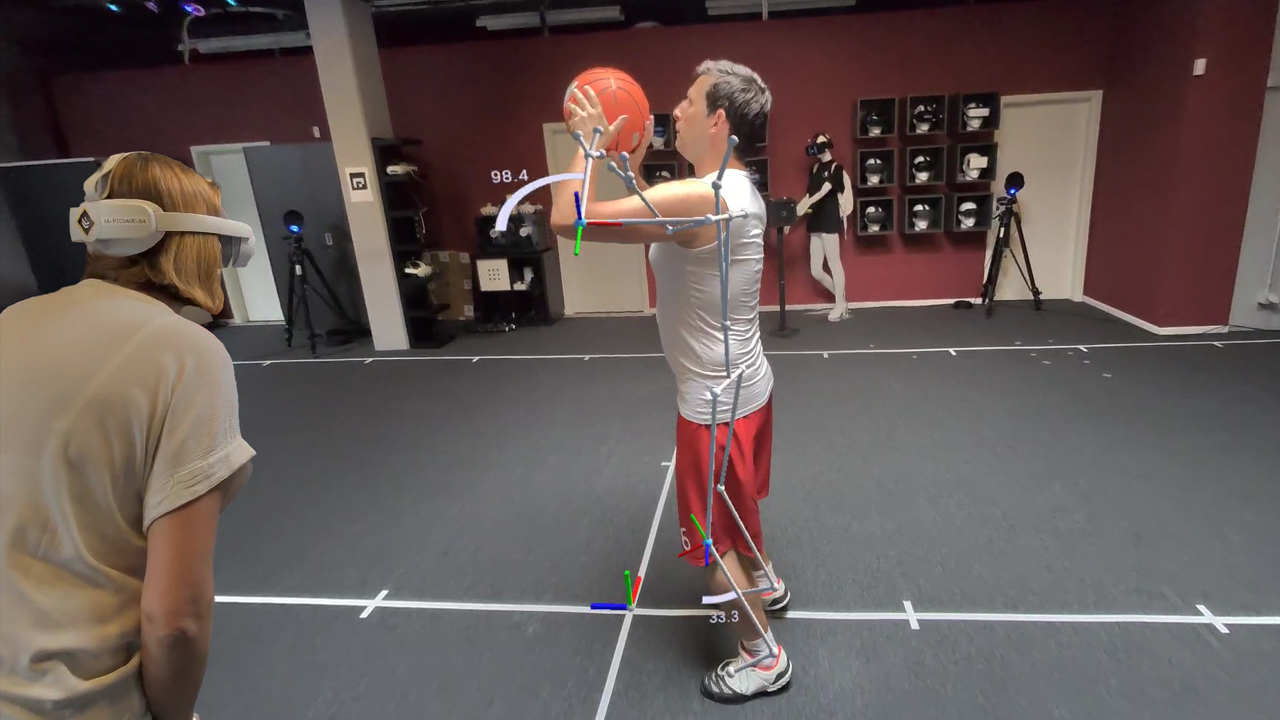
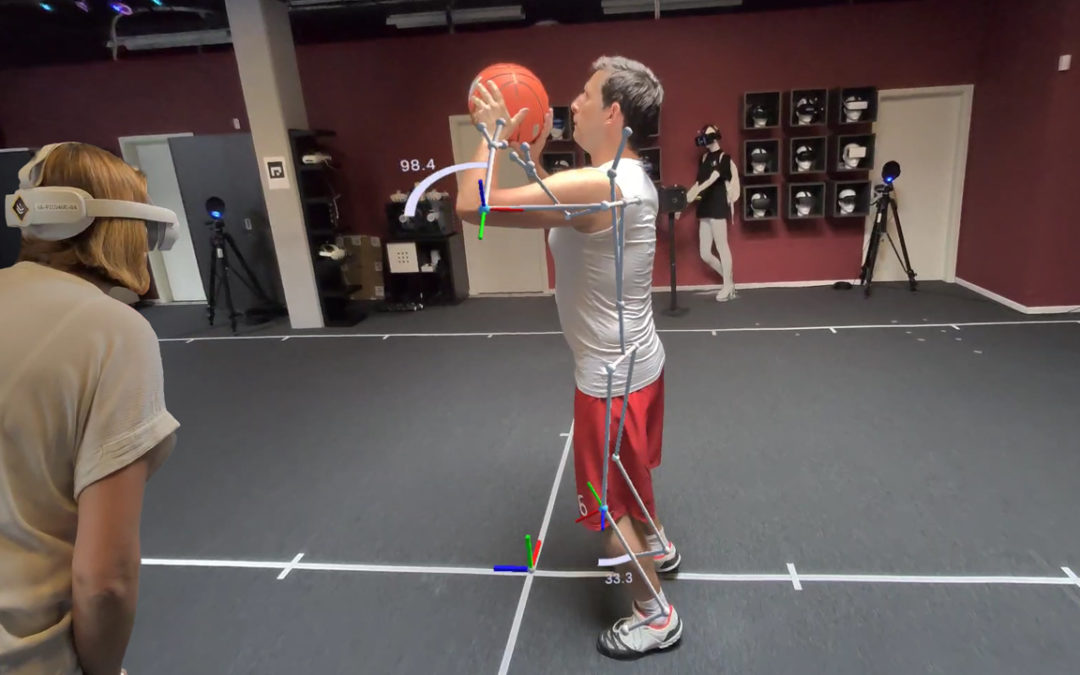
XRay explores how this motion data can be visualized directly in the examination space rather than only displayed on a conventional monitor. The project develops an augmented reality application that combines the video passthrough capabilities of modern XR headsets with real-time markerless tracking of one or more subjects, overlaying the reconstructed skeleton directly onto the live view of the patient.

Building on ideas first explored in the earlier HoloMed project, XRay takes advantage of recent advances in markerless motion capture, XR hardware and real-time visualization to investigate new approaches to movement assessment.

The application allows users to select relevant joints directly in space and visualize parameters such as joint angles and movement trajectories in real time. These tools can support the observation of specific regions of interest, for example during physical rehabilitation or functional movement assessment.

Throughout the project, Artanim is expanding the available visualization and analysis tools to investigate how the combination of markerless motion capture and augmented reality can support healthcare applications, with particular attention to education, evaluation and rehabilitation.
Real-Time Markerless Motion Capture

Real-Time Markerless Motion Capture

Real-Time Markerless Motion Capture

A machine-learning-based system for real-time multi-user motion capture without markers.

Project Info

Start date

September 2020

End date

September 2023

Funding

Artanim & Vicon

Coordinator

Artanim

Summary

Real-Time Markerless Motion Capture explores how machine learning can remove the need for physical markers in location-based virtual reality (LBVR) while preserving the speed and accuracy required for immersive multi-user experiences.

Traditional LBVR motion capture systems rely on active or passive infrared markers attached to users. While this provides stable and low-latency tracking, preparing participants with markers is time-consuming and creates additional maintenance and operational constraints.

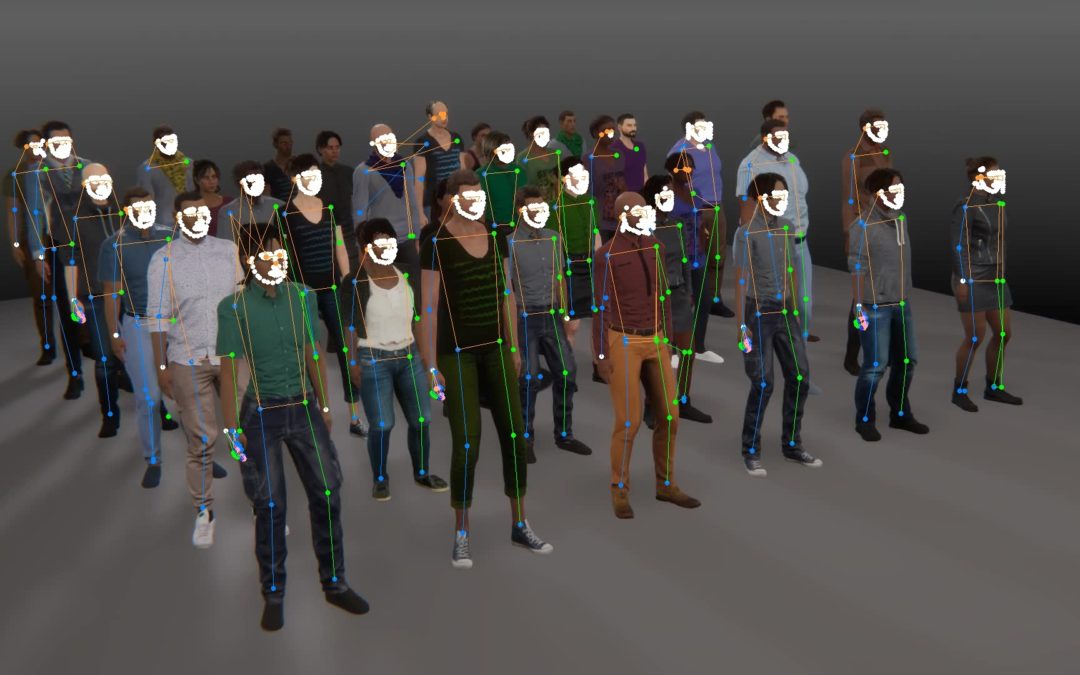
The project develops a markerless pipeline optimized for real-time performance. Camera images are processed at 60 frames per second, 2D body poses are estimated independently in each view, and the results are combined into full 3D skeletons. To meet the strict latency requirements of immersive VR, the pipeline is optimized across modern CPU and GPU architectures, balancing tracking accuracy with computational speed.

A second major challenge is the creation of sufficiently large and accurately annotated datasets for training machine-learning models. Rather than relying only on existing datasets, Artanim developed its Synthetic Factory to generate diverse virtual populations with variations in body shape, age, appearance, clothing, footwear, hairstyles and movement. Because the underlying virtual skeleton is known exactly, these synthetic subjects provide reliable ground-truth data for training and evaluation.

The project was developed in collaboration with Vicon. The first results were publicly demonstrated at SIGGRAPH 2023, where six participants were tracked simultaneously in real time without markers during The Clockwork Forest, a Dreamscape location-based VR experience created in partnership with Audemars Piguet. The showcase received a CGW Silver Edge Award for technological innovation.

Partners

Artanim
Definition of VR requirements, evaluation of machine-learning-based tracking algorithms, development of the Synthetic Factory, and implementation and fine-tuning of the multimodal tracking solution.

Vicon
Hardware development, implementation of machine-learning-based tracking algorithms, and real-time pose solving.

Related Publications

Nagorny P, Kevelham B, Chagué S, Charbonnier C. A Comprehensive Review of Real-Time Multi-View Multi-Person Markerless Motion Capture, ACM Comput Surv, 58(3):1–34, 2025.
PDF · DOI

VR+4CAD

VR+4CAD

VR+4CAD

A VR research project connecting CAD design, markerless interaction and user feedback.

Project Info

Start date

May 2020

End date

November 2021

Funding

Innosuisse – Project No. 42975.1 IP-ICT

Coordinator

Artanim

Website

VR+4CAD project website

Summary

VR+4CAD addresses several barriers limiting the adoption of virtual reality in manufacturing and design: incomplete interoperability between VR and CAD workflows, the friction involved in entering and interacting with virtual environments, and the limited feedback available for subsequent design analysis.

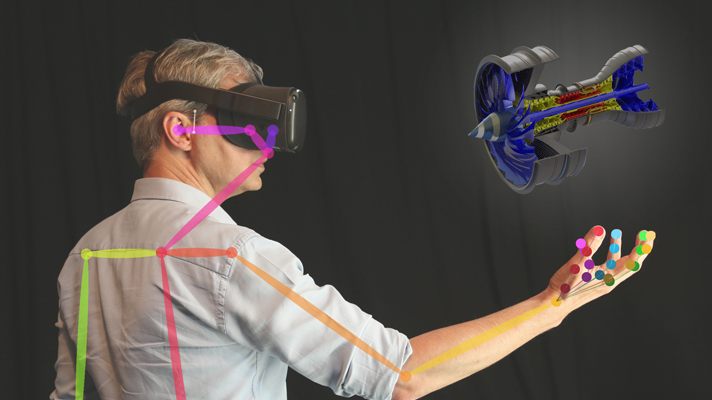
The project investigates how CAD-authored designs can be automatically converted and adapted for direct human interaction in VR. An experimental markerless motion capture system allows users to interact naturally with virtual prototypes without wearing dedicated tracking devices.

Motion data collected during each session is analyzed using activity recognition techniques to generate implicit feedback about user behavior and interaction. This information is combined with explicit user feedback and returned to the CAD operator, supporting the next iteration of the design process.

Partners

Caecilia Charbonnier – Artanim
Markerless motion capture, VR activity annotation and development of the interactive VR tools.

Silvia Giordano – University of Applied Sciences and Arts of Southern Switzerland (SUPSI)
CAD/VR interoperability and human activity recognition.